GRAVINER MK5, MK6 and MK7 Oil Mist Detector Main Units
GRAVINER Oil Mist Detectors are engine-protection systems designed to identify a dangerous increase in crankcase oil mist. Excessive oil mist may be created by overheating bearings, friction, lubrication failure or other developing mechanical problems.
Early detection allows the engine crew to investigate the condition before it develops into severe engine damage or a possible crankcase explosion.
The GRAVINER MK5, MK6 and MK7 represent different generations of Kidde Graviner Oil Mist Detector technology. Although their operating principle is similar, the main-unit design, detector arrangement, communication system and monitoring capacity differ significantly.
GRAVINER MK5, MK6 and MK7 Comparison
| Feature |
GRAVINER MK5 |
GRAVINER MK6 |
GRAVINER MK7 |
| System Generation |
Legacy centralized system |
Analogue addressable system |
Distributed auto-addressed system |
| Detection Arrangement |
Sequential sample-pipe system |
Individual detector heads |
Individual detector heads |
| Typical Capacity |
4–10 sampling points |
Up to 64 heads across 8 engines |
Up to 10 heads per control unit |
| Main Unit |
Combined detector/control unit |
Central main control panel |
Local control unit and optional remote display |
| Alarm Method |
Average, deviation and fault alarms |
Average, deviation and detector alarms |
Individual and average oil-mist alarms |
| Application |
Main or auxiliary engines |
Multi-engine installations |
Modern and retrofit installations |
| Replacement Status |
Legacy parts/replacement demand |
Widely installed legacy system |
Newer retrofit solution |
GRAVINER MK5 Main Unit
The GRAVINER MK5 is a centralized sample-pipe Oil Mist Detector. It sequentially draws an oil-mist sample from each connected crankcase compartment and measures its optical density.
Depending on configuration, the system can monitor approximately four to ten sample points. The main unit displays the sampling position, oil-mist level and system condition.
Typical MK5 indications include:
- System on
- Average oil-mist level
- Deviation alarm
- Main alarm
- Flow fault
- Optical fault
- Test mode
- Engine slowdown output
- Remote reset and test functions
The MK5 remains installed on many older main engines and auxiliary engines. Replacement main units, internal components and retrofit solutions are still frequently required.
Related Product: GRAVINER MK5 Oil Mist Detector
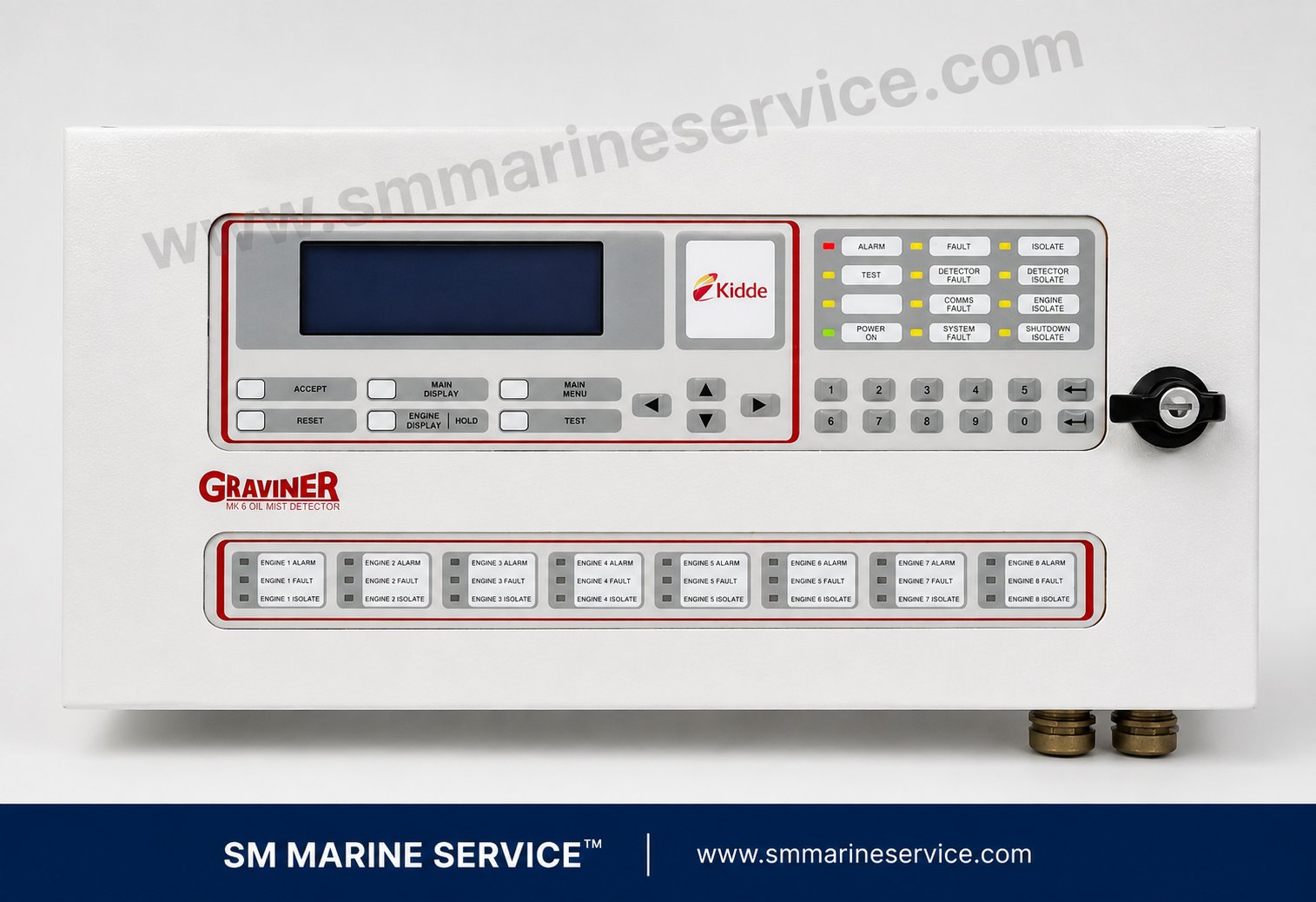
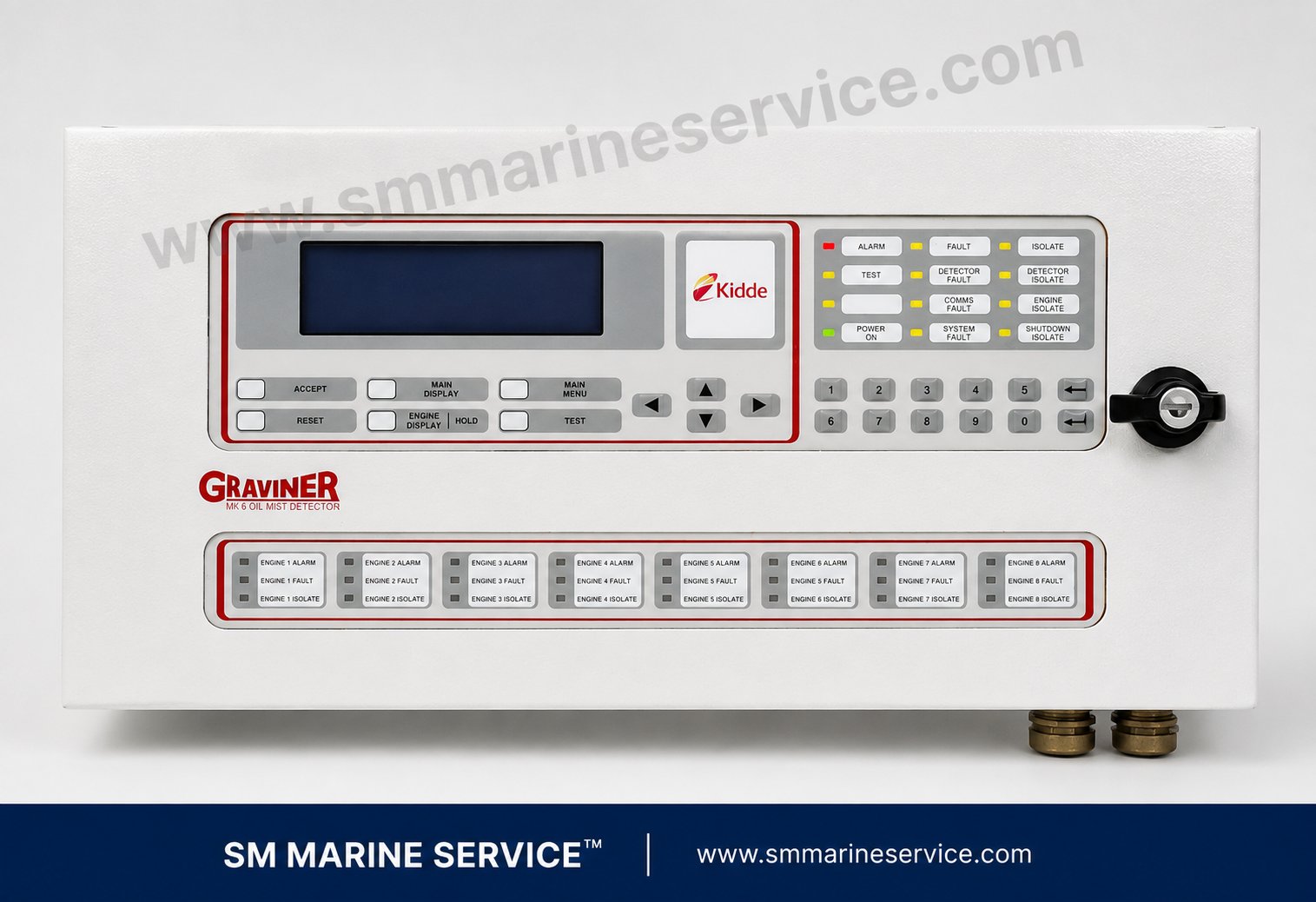
GRAVINER MK6 Main Control Unit
The GRAVINER MK6 is an analogue addressable Oil Mist Detection System. Each detector head monitors an individual crankcase compartment and sends oil-mist data to the central MK6 main control unit.
A complete system can monitor up to approximately 64 detector heads fitted across as many as eight engines. The main control unit separates the data according to engine groups and continuously displays average oil-mist density and alarm information.
Important MK6 main-unit functions include:
- LCD oil-mist indication
- Up to eight engine groups
- Average and deviation alarm monitoring
- Detector fault and isolation indication
- Communication-fault monitoring
- Engine alarm status
- Engine shutdown or slowdown interface
- Alarm acceptance and reset
- Detector and system testing
- Individual engine display
- Event and diagnostic information
Related Product: GRAVINER MK6 Oil Mist Detector Main Unit
GRAVINER MK7 Control and Display Units
The GRAVINER MK7 uses individually mounted detector heads with an engine-mounted control unit. This arrangement removes the need for long sampling pipes and allows continuous monitoring of each crankcase compartment.
One MK7 control unit can typically monitor up to ten detector heads. Multiple control units can be connected to an optional remote display system for larger multi-engine installations.
The MK7 system offers:
- Individual crankcase monitoring
- Automatically addressed detector heads
- Up to ten detector heads per control unit
- Multi-engine monitoring through connected control units
- Oil-mist level display
- Detector contamination monitoring
- Improved fault diagnostics
- Detector isolation facility
- Alarm and shutdown relay outputs
- Touch-screen remote display options
- Maintenance and configuration software support
- Easier retrofit from older OMD systems
Related Product: GRAVINER MK7 Oil Mist Detector
How a GRAVINER OMD Protects the Engine
Abnormal friction or lubrication failure can produce very high local temperatures on bearings and other moving engine parts. Lubricating oil contacting these surfaces can create a fine oil mist inside the crankcase.
The detector measures the concentration of this mist. If the oil-mist density rises above the configured average or deviation alarm level, the system activates an alarm and can provide a signal to the engine’s safety or slowdown system.
The alarm must be investigated according to the engine manufacturer’s procedures. It should never be repeatedly reset without determining the cause.
Common Main-Unit Faults
Main Unit Does Not Power On
Check the supply voltage, circuit breaker, fuse, power-supply board, terminal connections and internal wiring.
Communication Fault
Inspect the detector communication cable, cable termination, detector address and connectors. One damaged detector or cable section may affect communication with several heads.
Detector Fault or Detector Isolate
Check the indicated detector head, connector, cable, contamination level and address. Replace the detector only after confirming compatibility.
Optical or Optic-Test Failure
The detector’s optical chamber may be contaminated by oil deposits. Follow the approved cleaning and test procedure. Persistent failure may require detector-head servicing or replacement.
Flow Fault on MK5
Inspect sampling pipes, suction pressure, air passages, filters, valves and exhaust connection. Blocked or leaking pipes can prevent correct sampling.
False Oil-Mist Alarm
Possible causes include contaminated detector heads, incorrect settings, oil splash, blocked drainage, damaged wiring or an actual developing engine problem. Always treat the alarm as genuine until the engine condition has been checked.
Display or Keypad Failure
Inspect the LCD, membrane keypad, ribbon cable, display PCB and power supply. Replacement components must match the control-unit revision.
Maintenance Recommendations
- Perform the system test at the required interval.
- Record detector contamination values.
- Inspect detector heads for oil deposits.
- Clean detector optics according to the manual.
- Check cables and connectors for heat or vibration damage.
- Inspect MK5 sampling pipes for blockage and leakage.
- Check alarm, slowdown and shutdown relays.
- Verify detector addresses after replacement.
- Keep control-unit doors closed and sealed.
- Replace filters, wicks and service components as required.
- Maintain test and calibration records.
- Follow the applicable manufacturer and classification requirements.
A GRAVINER MK7 maintenance schedule recommends regular recording of contamination levels and inspection based on the engine’s operating condition.
Can MK5 or MK6 Be Replaced by MK7?
The GRAVINER MK7 can be considered for retrofit of older MK5 or MK6 installations, but it is not normally a direct plug-and-play main-unit replacement.
A retrofit assessment should consider:
- Engine make and model
- Number of crankcase compartments
- Existing detector-head arrangement
- Sampling pipes or detector mounting points
- Cable lengths and cable condition
- Alarm, slowdown and shutdown interfaces
- Control-room display requirements
- Power supply
- Classification and engine-manufacturer approval
Spare Parts and Replacement Availability
Depending on stock, support may be available for:
- GRAVINER MK5 main unit
- GRAVINER MK6 main control unit
- GRAVINER MK7 control unit
- MK7 remote display
- MK6 and MK7 detector heads
- Main processor and display PCB
- LCD and membrane keypad
- Alarm and relay boards
- Power-supply components
- Communication cables
- Detector bases and connectors
- Fans, filters and wicks
- Service and commissioning kits
- Used and refurbished complete systems
Part numbers, photographs, software revision and existing system configuration should be provided before ordering.
Why Are MK5 and MK6 Units Still Required?
A large number of vessels still operate with GRAVINER MK5 and MK6 systems. Replacing only a defective main unit, detector or PCB may allow the vessel to restore the existing OMD without changing every detector, cable and engine interface.
For this reason, tested used, refurbished and reconditioned units remain important for emergency replacement and planned maintenance.
Frequently Asked Questions
Are MK5, MK6 and MK7 main units interchangeable?
No. Their detector technology, communication, cabling and system configuration differ. Compatibility must be checked before replacement.
How many detectors can MK6 monitor?
A full MK6 system can monitor up to approximately 64 detector heads across eight engine groups.
How many detector heads can MK7 monitor?
One MK7 control unit can typically monitor up to ten detector heads. Multiple control units can be connected for larger systems.
Does MK7 require sampling pipes?
The MK7 uses detector heads mounted at individual crankcase compartments, eliminating the long sequential sample pipes used by the MK5.
Can a used main unit be installed directly?
The unit should first be tested, and its hardware revision, software, detector compatibility, alarm settings and engine configuration must be checked.
What information is required for a quotation?
Provide the model, part number, system generation, number of engines, number of detector heads, existing fault details and clear photographs of all nameplates.
Short Product Description
GRAVINER MK5, MK6 and MK7 Oil Mist Detector main units provide early warning of abnormal crankcase oil mist in marine diesel engines. Used, refurbished and replacement control units, detector heads, PCBs, displays and spare parts are available subject to stock and compatibility verification.
Manuals and Technical Resources
Contact SM MARINE SERVICE™
SM MARINE SERVICE™
Marine Automation, Engine Safety & Spare Parts Supplier
Available Condition:
- New Equipment
- Used Equipment
- Refurbished Equipment
- Reconditioned Equipment
Stock Location:
Services:
- Worldwide Shipping
- Technical Support
- Spare Parts Supply
- Marine Equipment Sourcing
- Oil Mist Detector Replacement Support
Contact Information
SM MARINE SERVICE™
Samir Market, DT Road, Pahartali, beside CDA Market, Chattogram, Bangladesh
Mobile / WhatsApp / Viber: +88 01818 929292
Email: info@smmarineservice.com
Website: www.smmarineservice.com