JRC NCR-333 NAVTEX Receiver – Complete Technical Guide, Operation, Maintenance & Troubleshooting
JRC NCR-333 NAVTEX Receiver
Complete Marine Technical Guide for Maritime Safety Information Reception
Product Identification
| Item | Details |
|---|---|
| Manufacturer | Japan Radio Co., Ltd. (JRC) |
| Country of Origin | Japan |
| Product Type | NAVTEX Receiver |
| Model | NCR-333 |
| System | NAVTEX Maritime Safety Information Receiver |
| Marine Application | GMDSS Safety Communication |
| Frequency | 518 kHz / 490 kHz / 4209.5 kHz (depending on configuration) |
| Compliance | IMO / SOLAS / GMDSS Requirements |
| Output Device | LCD Display & External Printer |
The JRC NCR-333 NAVTEX Receiver is a professional maritime safety communication system designed to automatically receive and display Maritime Safety Information (MSI), navigational warnings, meteorological warnings, search and rescue information, and other safety-related broadcasts transmitted through the international NAVTEX network.
Product Introduction
Maritime safety relies heavily on timely reception of navigational and weather information.
The JRC NCR-333 automatically receives and processes NAVTEX broadcasts without operator intervention, ensuring vessels continuously receive critical safety information.
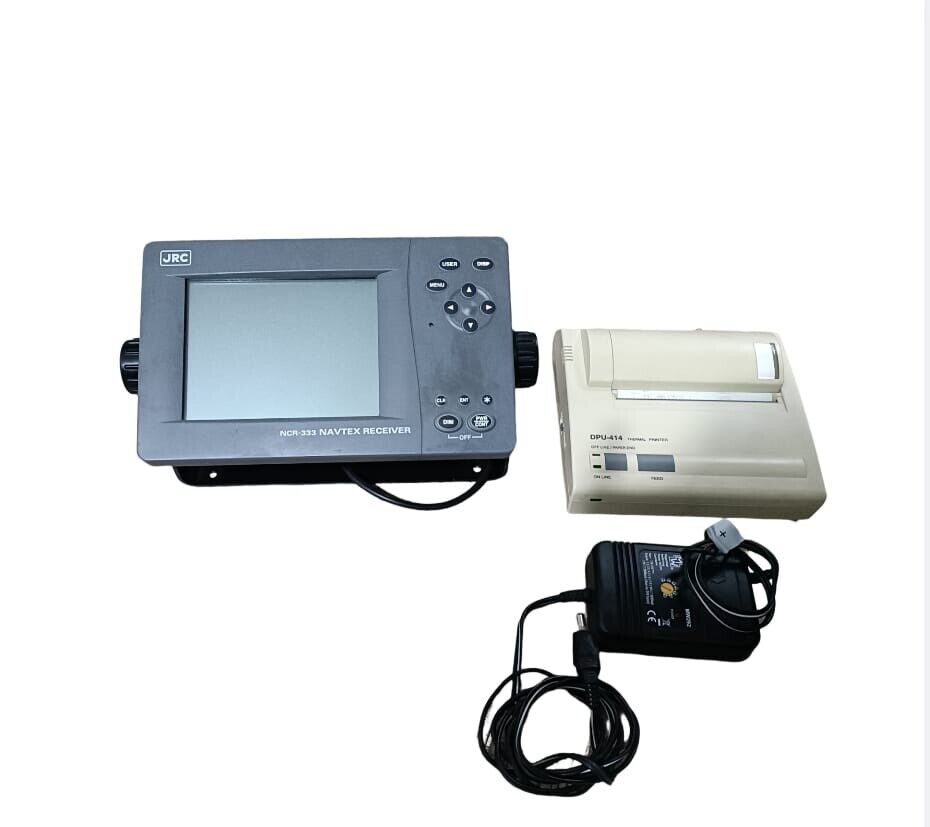
The system shown in the image includes:
- NCR-333 NAVTEX Display Unit
- DPU-414 External Printer
- Power Supply Unit
- NAVTEX Receiving System
The NCR-333 is commonly installed aboard:
- Container Ships
- Tankers
- Bulk Carriers
- Passenger Vessels
- Offshore Support Vessels
- Fishing Vessels
- Government Vessels
Main Product Image


The system automatically receives and stores navigational warnings and maritime safety information required for safe vessel operation.
What Is a NAVTEX Receiver?
NAVTEX (Navigational Telex) is an international automated service for broadcasting Maritime Safety Information (MSI).
The NAVTEX network provides:
- Navigational Warnings
- Meteorological Warnings
- Weather Forecasts
- Search and Rescue Information
- Pilot Service Messages
- Ice Reports
- Special Maritime Notices
The NCR-333 continuously monitors NAVTEX broadcasts and presents information to bridge personnel through its display and printer.
Typical NAVTEX Communication Network


Main Features
Automatic Message Reception
Continuously receives NAVTEX broadcasts without manual intervention.
GMDSS Compliance
Approved for SOLAS vessels requiring NAVTEX capability.
Multi-Frequency Reception
Supports international and national NAVTEX frequencies.
Message Storage
Stores received safety messages for future review.
LCD Display
Provides clear message presentation.
External Printer Support
Automatically prints received NAVTEX messages.
Message Filtering
Allows selection of specific message categories.
Alarm Functions
Provides alarms for important safety broadcasts.
User-Friendly Interface
Simple navigation and message management.
Display & Printer Functions


Main Components
1. Display Unit
Primary operator interface.
Functions
- Message Display
- Alarm Management
- Configuration
- Message Storage Access
2. NAVTEX Receiver Module
Receives NAVTEX broadcasts from coastal stations.
Functions
- Signal Reception
- Message Decoding
- Data Processing
3. External Printer (DPU-414)
Provides hard copies of received messages.
Functions
- Message Printing
- Record Keeping
- Compliance Documentation
4. Antenna System
Dedicated NAVTEX receiving antenna.
Functions
- Signal Reception
- Frequency Monitoring
5. Power Supply Unit
Provides regulated power to the complete system.
Typical System Architecture


Marine Applications
The NCR-333 is used for:
Maritime Safety Information Reception
Automatic MSI monitoring.
Navigation Safety
Receives warnings regarding hazards to navigation.
Weather Monitoring
Provides weather forecasts and storm warnings.
Search and Rescue Operations
Receives SAR-related information.
Regulatory Compliance
Supports GMDSS requirements.
Voyage Planning
Provides information affecting voyage safety.
Common Problems & Troubleshooting
1. No NAVTEX Messages Received
Possible Causes
- Antenna failure
- Receiver malfunction
- Incorrect frequency settings
Corrective Actions
- Verify antenna connections
- Check frequency configuration
- Inspect receiver diagnostics
2. Poor Signal Reception
Possible Causes
- Antenna damage
- Electromagnetic interference
- Poor installation location
Solution
- Inspect antenna system
- Check grounding
- Verify cable integrity
3. Printer Not Printing
Possible Causes
- Paper exhausted
- Printer fault
- Communication issue
Solution
- Replace paper roll
- Check printer connection
- Verify printer status
4. Corrupted Messages
Causes
- Weak signal strength
- Antenna problems
- Receiver interference
Solution
- Improve signal reception
- Inspect antenna system
- Verify grounding
5. Alarm Not Functioning
Causes
- Configuration issue
- Internal fault
Solution
- Verify alarm settings
- Perform system diagnostics
Maintenance Tips
Proper maintenance ensures reliable GMDSS performance.
Daily Checks
- Verify message reception
- Check alarm status
- Confirm printer operation
Weekly Checks
- Inspect antenna condition
- Verify message storage
- Check system logs
Monthly Checks
- Test alarm functions
- Verify printer performance
- Inspect power supply
Annual Maintenance
Recommended:
- Antenna inspection
- Receiver testing
- Printer servicing
- System performance verification
Paper Supply Management
Always maintain adequate printer paper stock for continuous operation.
Why Ships Still Use NAVTEX
Despite modern satellite communications, NAVTEX remains important because:
GMDSS Requirement
Required on many SOLAS-class vessels.
Automatic Reception
No operator action required.
Reliable Safety Information
Direct delivery of official warnings.
Independent Communication Source
Provides redundancy alongside satellite systems.
Low Operating Cost
No airtime charges.
Global Maritime Acceptance
Recognized internationally as an official MSI service.
Frequently Asked Questions (FAQ)
What is the main purpose of the NCR-333?
To automatically receive Maritime Safety Information (MSI) broadcasts.
Does NAVTEX require satellite communication?
No. NAVTEX uses terrestrial radio broadcasts.
Can the NCR-333 print messages automatically?
Yes. Through the connected DPU-414 printer.
Is NAVTEX mandatory?
For many SOLAS vessels operating in NAVTEX coverage areas, yes.
What types of messages are received?
Navigational warnings, weather forecasts, meteorological warnings, SAR information, and safety notices.
Short Product Description
The JRC NCR-333 NAVTEX Receiver is a professional maritime safety communication system designed to automatically receive, display, store, and print Maritime Safety Information (MSI). Featuring GMDSS compliance, multi-frequency reception, automatic message handling, and printer integration, it remains an essential safety communication tool aboard commercial vessels worldwide.