Marine Magnetic Compass – Complete Guide, Applications, Maintenance & Troubleshooting | SM MARINE SERVICE™
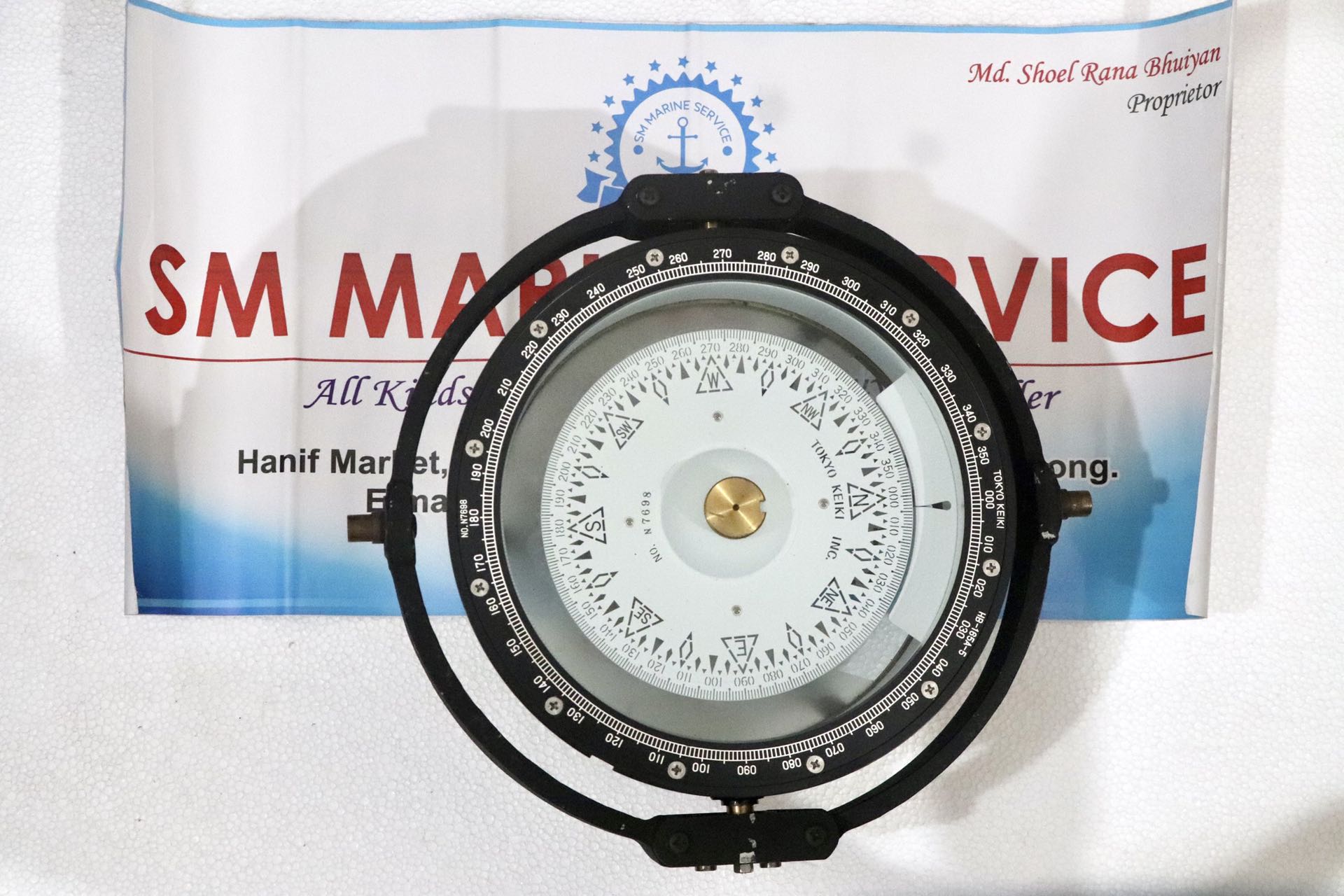
Marine Magnetic Compass
Complete Technical Guide, Applications, Maintenance, Troubleshooting & Marine Navigation Importance


Product Introduction
The Marine Magnetic Compass is one of the oldest and most reliable navigation instruments used onboard ships. Despite the advancement of modern navigation systems such as ECDIS, GPS, Gyro Compass, AIS, Radar, and Integrated Bridge Systems, the magnetic compass remains a mandatory and essential navigation instrument on vessels worldwide.
Unlike electronic navigation equipment, a magnetic compass requires no satellite signal, no software, and minimal electrical support. It provides a simple and dependable directional reference based on the Earth's magnetic field.
Today, magnetic compasses are installed onboard:
- Cargo Ships
- Container Vessels
- Oil Tankers
- Chemical Tankers
- Bulk Carriers
- Passenger Ships
- Offshore Vessels
- Fishing Vessels
- Naval Ships
- Tug Boats
What Is a Marine Magnetic Compass?
A Marine Magnetic Compass is a navigation instrument that indicates vessel heading by aligning itself with the Earth's magnetic field.
Unlike a gyro compass, which points toward True North, a magnetic compass points toward Magnetic North.
The magnetic compass serves as an independent navigation reference and is often used as a backup navigation system when electronic equipment becomes unavailable.
Major international maritime regulations still require vessels to carry properly adjusted magnetic compasses.


Main Features
Independent Navigation Instrument
Requires no GPS signal or satellite communication.
Continuous Heading Reference
Provides constant directional information.
Emergency Navigation Backup
Functions even during complete electrical failure.
IMO & SOLAS Compliance
Required onboard most commercial vessels.
Long Operational Life
Can remain operational for decades with proper maintenance.
Simple Construction
Reliable and easy to maintain.
No External Signal Required
Works independently of external communication systems.
Global Acceptance
Used onboard vessels operating worldwide.
Main Components of a Marine Magnetic Compass
Compass Bowl
Contains the compass card and magnetic element.
Compass Card
Displays heading information in degrees.
Magnetic Needles
Align with the Earth's magnetic field.
Lubber Line
Provides vessel heading reference.
Binnacle
Supports and protects the compass assembly.
Corrector Magnets
Used for deviation correction.
Heeling Magnets
Compensate for vertical magnetic influence.
Lighting Arrangement
Allows night-time compass reading.


Applications
Marine Magnetic Compasses are commonly used for:
- Primary Compass Reference on Small Vessels
- Emergency Navigation
- Steering Reference
- Compass Error Verification
- Gyro Compass Cross-Checking
- Coastal Navigation
- Ocean Navigation
- Naval Operations
- Fishing Vessel Navigation
- Training and Maritime Education
Common Problems & Troubleshooting
Excessive Compass Deviation
Possible Causes:
- Nearby Magnetic Materials
- Electrical Equipment Interference
- Incorrect Corrector Magnet Adjustment
Solution:
- Conduct Compass Adjustment
- Remove Magnetic Sources
- Verify Corrector Magnet Settings
Air Bubble Inside Compass Bowl
Possible Causes:
- Fluid Leakage
- Temperature Changes
- Aging Components
Solution:
- Inspect Compass Fluid
- Replace Seals if Necessary
- Refill According to Manufacturer Specifications
Poor Heading Stability
Possible Causes:
- Vessel Vibration
- Compass Damage
- Internal Wear
Solution:
- Inspect Mounting Condition
- Verify Internal Assembly
- Perform Operational Testing
Compass Card Sticking
Possible Causes:
- Mechanical Damage
- Contaminated Fluid
- Internal Wear
Solution:
- Inspect Compass Bowl
- Clean or Replace Components
- Conduct Performance Check
Lighting Failure
Possible Causes:
- Burned Bulb
- Wiring Fault
- Power Supply Failure
Solution:
- Replace Lamp
- Check Wiring
- Verify Voltage Supply
Compass Deviation & Compass Correction
One of the most important aspects of magnetic compass operation is controlling compass deviation.
Deviation occurs due to magnetic influences onboard the vessel.
Common sources include:
- Steel Structures
- Electrical Motors
- Generators
- Transformers
- Power Cables
- Magnetic Cargo
Professional compass adjustment is performed to minimize deviation and maintain navigation accuracy.
Maintenance Tips
Marine engineers and navigators should regularly inspect:
- Compass Fluid Condition
- Air Bubble Formation
- Compass Card Movement
- Compass Lighting
- Corrector Magnet Condition
- Binnacle Integrity
- Mounting Security
- Compass Deviation Records
Regular inspections significantly improve navigation safety and reliability.


Why Ships Still Use Magnetic Compasses
Even in the era of modern electronic navigation systems, magnetic compasses remain essential because:
- No Satellite Dependency
- No Software Dependency
- Reliable During Power Failure
- Independent Heading Source
- IMO Compliance Requirement
- Simple Maintenance
- Long Service Life
- Trusted Backup Navigation Instrument
Many marine incidents have demonstrated the importance of maintaining a reliable backup navigation system, making the magnetic compass an indispensable instrument onboard.
Frequently Asked Questions (FAQ)
What is the difference between a Magnetic Compass and a Gyro Compass?
A magnetic compass points to Magnetic North, while a gyro compass points to True North.
Does a Magnetic Compass require electricity?
Generally, no. Only the compass illumination may require electrical power.
Can a Magnetic Compass be used during GPS failure?
Yes. It operates completely independently of GPS.
Why is compass adjustment necessary?
To reduce magnetic deviation caused by vessel structures and equipment.
Is a Magnetic Compass still mandatory onboard ships?
Yes. International maritime regulations continue to require magnetic compasses on many vessel types.
Major Marine Magnetic Compass Manufacturers
SM MARINE SERVICE™ can supply magnetic compasses from various international manufacturers, including:
- Tokyo Keiki (Japan)
- Cassens & Plath (Germany)
- C. Plath (Germany)
- Saura Keiki (Japan)
- Ritchie Navigation (USA)
- Kelvin Hughes (UK)
- Furuno Integrated Compass Solutions
- Various IMO & SOLAS Compliant Marine Compass Brands
Availability depends on stock and vessel requirements.
Short Product Description
A Marine Magnetic Compass is a fundamental ship navigation instrument that provides heading information based on the Earth's magnetic field. It remains one of the most reliable and widely used navigation devices onboard commercial, offshore, fishing, and naval vessels worldwide.
User Manual & Technical Resources
Because this article covers Marine Magnetic Compasses in general rather than a specific model, there is no single universal manual.
User Manual & Technical Resources
Because this article covers Marine Magnetic Compasses in general rather than a specific model, there is no single universal manual.
General Marine Magnetic Compass Resources:
Product Manuals
Download PDF Click Here