Gyro Compass Units
Sperry Marine
Refurbished
Manufacturer: Sperry Marine
Model: MK 37 VT
Country of Origin: USA (original documentation identifies Sperry Marine Inc., Charlottesville, Virginia)
Product Type: Digital Electromechanical Gyrocompass
Marine Application: True-heading generation and distribution for shipboard navigation systems
The Sperry Marine MK 37 VT Digital Gyrocompass is a proven marine heading-reference system widely installed on commercial vessels. It provides stabilized true-heading information for equipment such as radar, autopilot, ECDIS, AIS, VDR/S-VDR and heading repeaters.
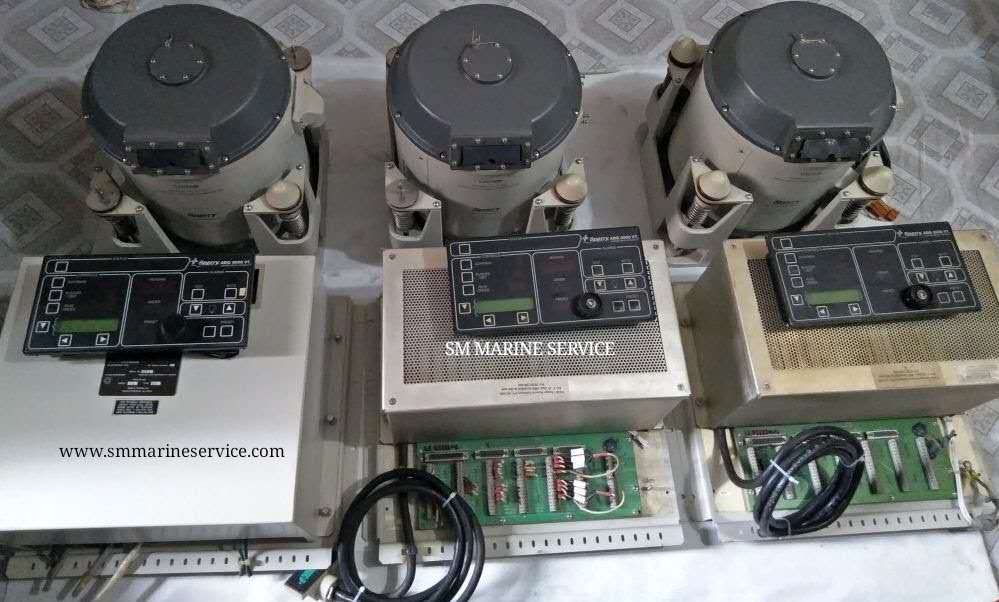
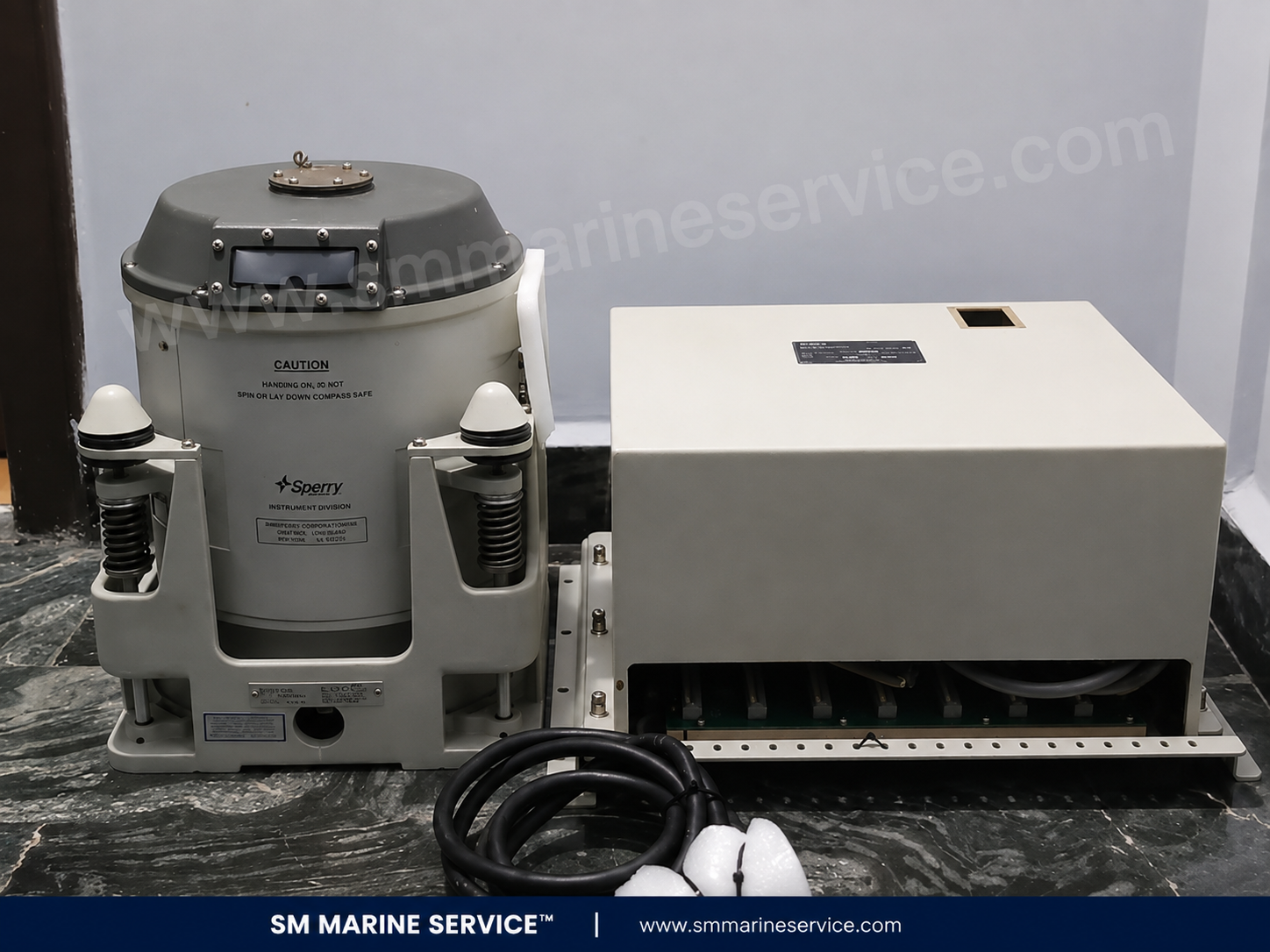
The uploaded photograph shows complete MK 37 VT installations comprising the master compass, digital display/control assembly and electronics/control equipment.
The MK 37 VT is an electromechanical gyrocompass designed to automatically seek and maintain the ship's true-north reference.
Unlike a magnetic compass, its heading reference is not dependent on the Earth's magnetic field. The system uses gyroscopic inertia together with the effects of Earth's rotation and gravity to establish the meridian.
A particularly important feature is its three-precision-gimbal master compass. The gyroscope rotor is contained inside a gyrosphere immersed in silicone fluid and adjusted for neutral buoyancy. This reduces loading on sensitive bearings and helps protect the compass element against shock.

The MK 37 VT is a complete true-heading generation and distribution system, rather than simply a gyro sensor.
Its basic architecture consists of three major units:
Master Compass → Electronics Control Unit → Display/Control Assembly
Heading is corrected using vessel speed and latitude information. According to the original technical brochure, latitude correction can be automatic from GPS input or manually entered, while speed correction can use a speed-log input or manual speed entry.
Once corrected, heading information can be distributed to other bridge equipment in both digital and step-data formats.
The MK 37 VT combines traditional Sperry electromechanical gyro technology with digital processing and shipboard interfaces.
Key capabilities include:
The technical brochure specifies eight 24 VDC step-data outputs at six steps per degree and an analog rate-of-turn output of 50 mV per degree/minute, with ±4.5 V corresponding to ±90°/minute.

This is the cylindrical gyro assembly visible behind the control panel in the supplied photograph.
Inside is the precision gyro element/gyrosphere responsible for establishing the true-heading reference.
The silicone-fluid suspension provides important mechanical protection and reduces loading on the sensitive-axis bearings.
The Electronics Unit performs control, correction, monitoring and heading-distribution functions.
It receives speed and latitude information, processes gyro information and supplies corrected heading to external equipment.
The original brochure specifies an approximate Electronics Unit weight of 18 kg.
The front panel provides heading indication, system status, operator settings and alarm controls.
Typical controls and indications include:
GYRO – SPEED – LATITUDE – HEADING – ALARMS – TEST – MUTE
The original technical data gives the Display Assembly an approximate weight of 5.5 kg.
The gyrosphere is one of the most important replacement components in an aging MK37 VT.
It contains the gyro rotor and forms the sensitive element responsible for establishing heading.
Corrected heading can be distributed to external ship systems through serial and step outputs. The MK 37 VT documentation specifies one RS-422 and two RS-232 serial heading outputs using NMEA 0183.
| Parameter | MK 37 VT |
|---|---|
| Equipment | Digital Gyrocompass |
| Master Compass | Electromechanical, three-gimbal |
| Latitude Correction | Automatic or manual |
| Speed Correction | Automatic or manual |
| Serial Inputs | RS-232 / RS-422 |
| Speed Input | NMEA 0183 VHW/VBW |
| Position/Latitude Input | GGA/GLL |
| Serial Heading Outputs | RS-422 + RS-232 |
| Step Outputs | 8 channels, 24 VDC |
| Step Resolution | 6 steps/degree |
| Rate-of-Turn Output | Analog |
| Supply | 115/230 VAC, 47–64 Hz |
| DC Supply | 24 VDC |
| Master Compass Weight | Approx. 38 kg |
| Electronics Unit Weight | Approx. 18 kg |
| Display Weight | Approx. 5.5 kg |
| Unaided Settle Time | Less than 5 hours |
These values are taken from published MK 37 VT technical literature.
The MK 37 VT can act as the vessel's central true-heading source.
Typical connected equipment includes:
A stable heading source is particularly important because a gyro failure can affect several bridge systems simultaneously.
A healthy gyro requires time to settle after startup. The published specification states an unaided settling time of less than five hours.
If heading remains unstable, inspect the gyro element, power supply, control electronics, speed/latitude information and mechanical condition.
The service documentation identifies Fault 30 as an auto-level/fast-settle failure where normal settling may be required.
Possible causes include:
Incorrect latitude → incorrect speed input → sensor/interface error → gyro element problem → control electronics fault.
Always compare gyro heading with an independent heading reference before changing internal adjustments.
If the master display is correct but radar, ECDIS or autopilot has no gyro heading, inspect the output rather than immediately condemning the master compass.
Check:
RS-422 → RS-232 → step outputs → cabling → terminal connections → receiving equipment.
The MK37 VT manual identifies faults associated with missing speed-log serial data. Check the speed-log source, NMEA communication and wiring.
The manual includes serial-input/output fault conditions covering missing data, framing errors and communication problems.
Inspect baud/protocol configuration, wiring polarity, connectors and the transmitting device.
Critical startup faults include PROM checksum and volatile RAM read/write failures.
The manual advises cycling power to determine whether such a fault clears; persistent critical faults require an alternative heading source and technical repair.
Excessive spin-motor current can indicate a significant gyro or control problem and should not simply be reset repeatedly.
The equipment should be inspected by personnel familiar with the MK37 VT.
In dual installations, an alarm may occur when the difference between the two corrected headings exceeds the configured tolerance.
This may indicate a malfunctioning compass, although an unnecessarily narrow tolerance during maneuvering can also cause an alarm.
Periodic inspection is particularly important because most MK 37 VT systems currently in service are mature installations.
Check the master compass, shock mounts, electronics unit, display, connectors, power supply, heading outputs and external sensor inputs.
Keep ventilation openings clean and ensure that electronic assemblies are not exposed to excessive dust, moisture or corrosion.
Heading accuracy should periodically be compared with an independent reference.
Speed and latitude inputs should also be checked because erroneous external information can affect corrected gyro heading.
Most importantly, avoid unnecessary dismantling of the compass element.
The MK37 VT service documentation specifically cautions that repairs below the top plate of the compass element are outside normal onboard repair scope and recommends that master-compass repairs be performed by qualified Sperry service personnel except under emergency conditions.
The MK37 VT remains relevant because of its robust electromechanical construction, extensive heading-output capability and long history of commercial marine operation.
Many older ships were designed around its interfaces. Replacing the entire gyro system can involve modifications to radar, autopilot, repeaters, ECDIS, AIS, VDR and bridge wiring.
For such vessels, sourcing a compatible MK37 VT master compass, gyrosphere, control/display panel, electronics unit or PCB can sometimes be more practical than immediately converting the entire heading-distribution system.
It is a digital electromechanical marine gyrocompass designed to provide true-heading information to the vessel and connected bridge-navigation equipment.
Yes. Speed and latitude are used for heading correction. They can be supplied automatically from compatible navigation equipment or entered manually.
Depending on installation and interface configuration, radar, ECDIS, autopilot, AIS, VDR, repeaters and other navigation equipment can use its heading information.
Published technical information specifies 115/230 VAC ±10%, 47–64 Hz, together with 24 VDC supply requirements in the system architecture.
The published specification states less than five hours unaided.
Limited troubleshooting and replaceable-board work can be performed according to the service manual, but internal compass-element work should be handled with considerable caution. The manual recommends specialist service for master-compass repairs.
The Sperry Marine MK 37 VT Digital Gyrocompass is a commercial shipboard true-heading system incorporating an electromechanical three-gimbal master compass, electronics control unit and digital display/control assembly. It provides corrected heading through digital and step-data outputs for radar, ECDIS, autopilot, AIS, VDR, repeaters and other bridge equipment. The system supports automatic or manual speed and latitude correction and can also be configured as a dual-gyro installation.
Marine Automation & Navigation Equipment Supplier
Available Condition:
• New Equipment • Used Equipment • Refurbished Equipment • Reconditioned Equipment
Stock Location:
• Bangladesh • China
Services:
• Worldwide Shipping • Technical Support • Spare Parts Supply • Marine Equipment Sourcing
Contact Information
SM MARINE SERVICE™ Samir Market, DT Road, Pahartali, beside CDA Market, Chattogram, Bangladesh
Mobile / WhatsApp / Viber: +88 01818 929292
Email: info@smmarineservice.com
Website: www.smmarineservice.com
0
BDT 0
BDT 0
BDT 0

BDT 0
Marine Equipment Supplier