
Jotron Phontech 4005 / 4016 Intrinsically Safe Telephone
Jotron
Refurbished
The Jotron Phontech 4005 / 4016 Intrinsically Safe Telephone is a rugged marine communication station designed for use within compatible sound-powered or batteryless telephone systems, particularly where explosion-protected equipment is required.
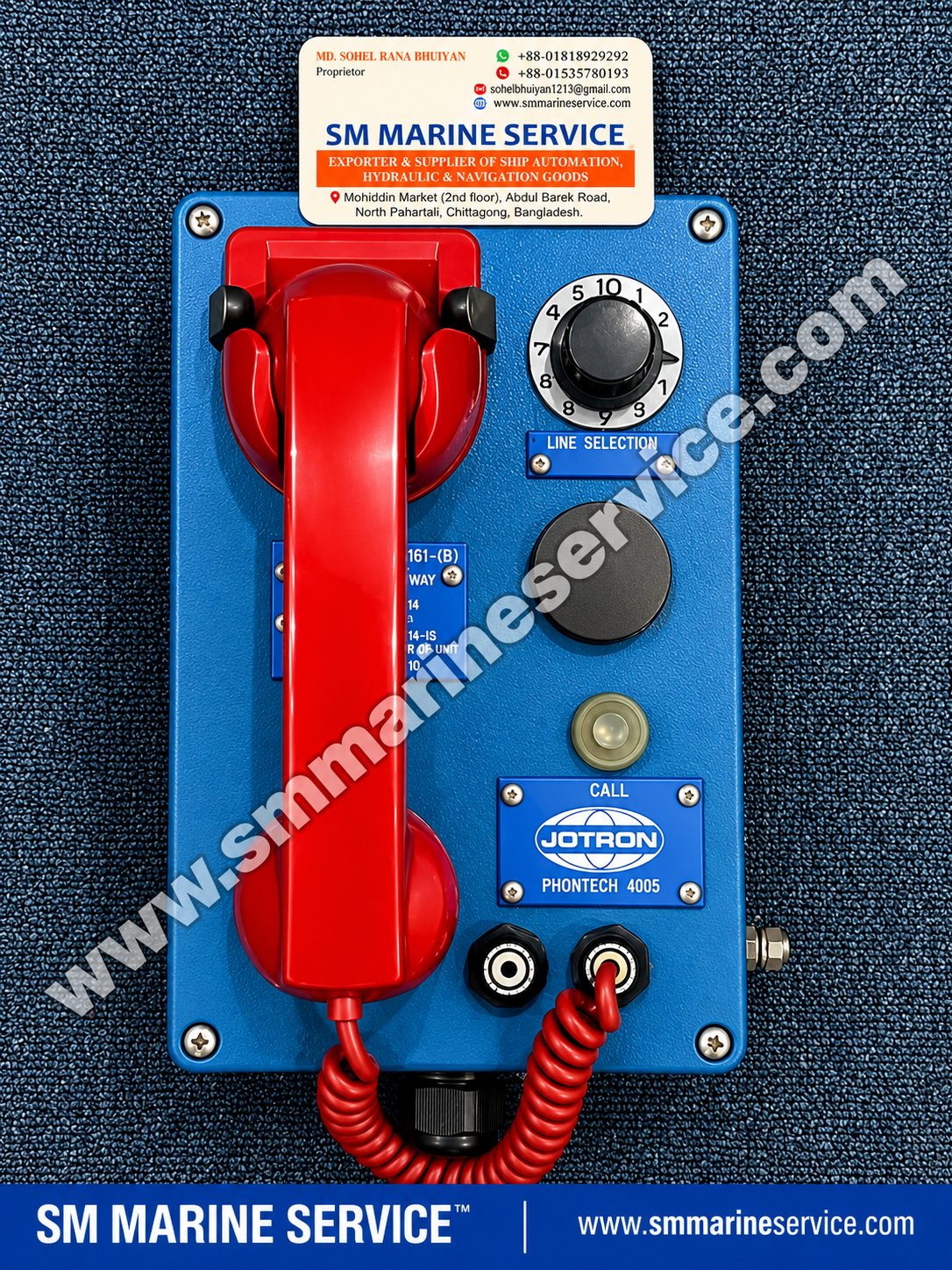
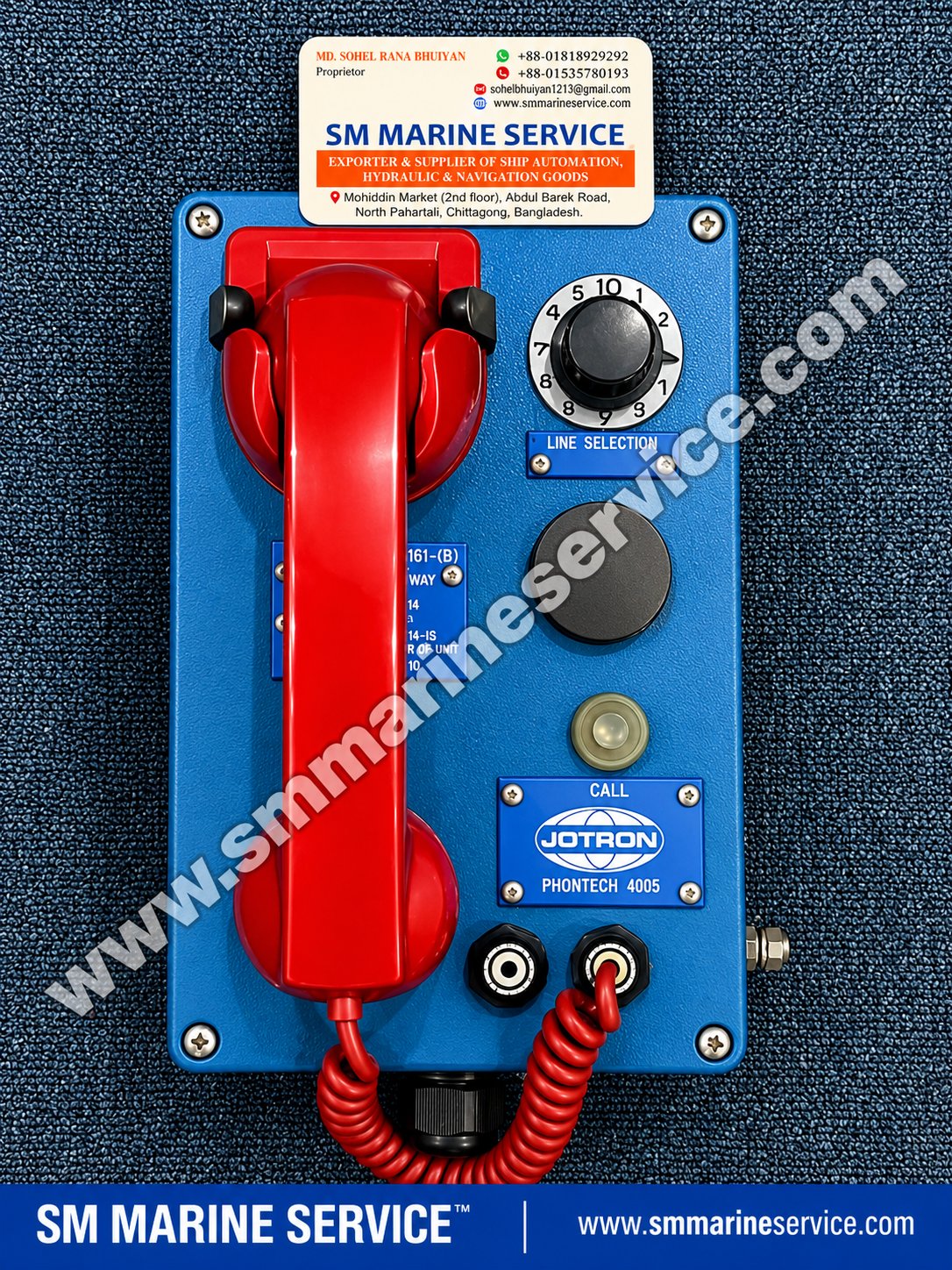
The photographed unit carries a front identification plate marked JOTRON PHONTECH 4005, while its certification nameplate identifies the type family as 4005(-B) / 4016(-B).
It features a distinctive red telephone handset, blue wall-mounted enclosure, rotary line-selection control, CALL push button and hazardous-area certification markings.
These features make it relevant to vessel operators and marine engineers maintaining emergency communication installations aboard tankers, gas carriers, offshore facilities and other ships equipped with compatible Phontech BTS 4000 systems.
SM MARINE SERVICE™ supports international enquiries for Jotron Phontech marine telephones and related communication spare parts through www.smmarineservice.com.
Original SM MARINE SERVICE™ product photograph — Jotron Phontech 4005 front assembly.
|
Parameter |
Product Details |
|---|---|
|
Manufacturer on nameplate |
JOTRON AS |
|
Brand |
PHONTECH |
|
Front model identification |
PHONTECH 4005 |
|
Certified type family |
4005(-B) / 4016(-B) |
|
Product Type |
Intrinsically safe marine telephone |
|
Associated System |
BTS 4000 batteryless telephone system |
|
Manufacturer Location |
3185 Skoppum, Norway |
|
Ex Marking |
Ex ib IIB T4 Gb |
|
Equipment Category Marking |
II 2G |
|
Certificate |
NEMKO 03ATEX1504 |
|
CE Marking |
CE 0470 |
|
Safety Parameter Documents |
88400-002-IS and 92400-014-IS |
|
Serial Number |
Refer to rear of unit |
|
Production Year |
Refer to rear of unit |
|
Enclosure |
Blue wall-mounted industrial housing |
|
Handset |
Red handset with coiled cord |
|
Line Selection |
Rotary selector |
|
Call Control |
CALL push button |
|
Condition |
Not independently verified |
Important model distinction: The certification plate covers the 4005/4016 type family. It does not mean that a particular telephone is simultaneously a 4005 and a 4016. The photographed front plate identifies this unit as PHONTECH 4005.
The Phontech 4005 is an intrinsically safe telephone station associated with marine sound-powered communication systems.
Sound-powered telephone technology uses energy generated by the voice transducer to carry speech through a compatible circuit. This makes the technology particularly useful for emergency communications where dependence on a conventional powered telephone exchange is undesirable.
In a correctly designed batteryless installation, the speech circuit can remain usable during a loss of the ship's normal electrical supply.
However, auxiliary calling devices, amplifiers, buffers and interfaces may have separate electrical requirements. The complete installation must therefore be evaluated rather than assuming every associated function is power-independent.
The intrinsically safe design is particularly important in areas where flammable gas atmospheres may be present.
Unlike a standard industrial telephone, an intrinsically safe unit is designed and assessed to limit the electrical and thermal energy available for ignition under specified conditions.
The telephone, associated barriers, wiring and installation must all satisfy the relevant hazardous-area requirements.
The manufacturer's plate displays Ex ib IIB T4 Gb, indicating an intrinsically safe equipment protection concept with a specified gas group, temperature class and equipment protection level.
The exact installation conditions are governed by the certified equipment configuration and applicable documentation.
The telephone includes a substantial red handset connected to the housing through a coiled cable.
This arrangement is suitable for communication stations where personnel may need to operate the telephone while wearing protective clothing.
A front-mounted selector marked LINE SELECTION allows the operator to choose among configured communication lines or stations.
The photographed selector shows multiple numbered positions.
The actual number of usable stations depends on the telephone variant and connected system.
A clearly labelled CALL push button is installed on the front panel.
It forms part of the station's calling arrangement, subject to the system configuration.
The robust blue enclosure provides a fixed mounting arrangement for marine or offshore communication stations.
The visible construction includes a handset cradle, panel fasteners, cable entries and accessory connections.
Two circular connection points are visible near the bottom of the enclosure.
Their exact pin assignments and approved accessory functions require verification before connecting a headset or other equipment.
|
Specification |
Details |
|---|---|
|
Model shown |
Phontech 4005 |
|
Certified type family |
4005(-B) / 4016(-B) |
|
Communication principle |
Sound-powered / batteryless system |
|
Hazardous-area marking |
Ex ib IIB T4 Gb |
|
Equipment marking |
II 2G |
|
Certificate reference |
NEMKO 03ATEX1504 |
|
CE marking |
CE 0470 |
|
Handset |
Red corded handset |
|
Selector |
Rotary line selection |
|
Call control |
Push button |
|
Mounting |
Wall/bulkhead |
|
Housing material |
Reported as cast aluminium; not independently verified |
|
Approximate dimensions |
160 × 260 × 175 mm, supplied reference estimate |
|
Approximate weight |
3.4–4.0 kg, supplied reference estimate |
|
External speech power |
Not normally required for a correctly configured sound-powered speech circuit |
|
Auxiliary electrical requirements |
Depend on the connected system |
|
Serial number |
Rear of unit |
|
Production year |
Rear of unit |
The supplied catalogue estimates for dimensions and weight should be checked against the exact variant before they are used for packing or shipping calculations.
The BTS 4000 family includes several telephone stations and associated interface devices. Exact article numbers are valuable for purchasing departments because similar-looking equipment may have different line capacities, calling arrangements or hazardous-area approvals.
|
Model / Part Number |
Description |
|---|---|
|
4005 – 12091 |
Intrinsically safe telephone |
|
4005 with buzzer – 16386 |
Intrinsically safe telephone with buzzer |
|
4016 – 12554 |
Intrinsically safe telephone, 24-line version |
|
4016B – 16744 |
Intrinsically safe telephone with buzzer, 24-line version |
|
4004 – 12070 |
Intrinsically safe buffer unit |
|
4015 – 12553 |
Intrinsically safe buffer unit |
|
16301 |
Intrinsically safe barrier for two additional lines |
|
4000 – 11289 |
Speech amplifier unit |
|
4040 |
24-line batteryless telephone |
|
4050 / 4051 |
Single-line batteryless telephone variants |
|
4060 / 4061 |
12-line batteryless telephone variants |
|
0018 / 9010 |
Associated headset types |
|
99400-010 |
Plug-in relay board referenced for BTS telephones |
|
9021305004 |
Complete replacement handset listed for P-4005 / P-4016 |
The historical Phontech product catalogue confirms the 4005, 4016, buffer-unit and barrier identifiers. The current replacement-handset listing confirms part number 9021305004.
Compatibility warning: These numbers identify related products and components, not a list of automatically interchangeable replacements. Some equipment requires a specific certified installation arrangement.
The 4005 is listed as an intrinsically safe telephone. Historical catalogues identify article number 16386 as a 4005 telephone fitted with a buzzer.
The suffix and associated calling arrangement should be confirmed against the original order details.
The 4016 belongs to the 24-line intrinsically safe telephone range. The 4016B is identified as the buzzer-equipped version.
Although the 4005 and 4016 share a certified type-family designation, the line configuration and associated components must be checked before replacement.
The 4015 is an associated intrinsically safe buffer unit used in compatible BTS 4000 installations.
It is not itself a replacement for the 4005 telephone. Its purpose is to support the appropriate intrinsically safe interface arrangement.
The 16301 is listed as an intrinsically safe barrier associated with additional communication lines.
Barrier selection is a safety-critical matter. Only an approved and documented barrier arrangement should be used for the applicable Ex installation.
A complete handset replacement for P-4005/P-4016 is identified under 9021305004.
This is an important purchasing keyword for customers who require a replacement handset rather than the complete telephone assembly. The replacement handset's appearance or color may differ from an original installed handset, and the approved configuration must be checked.
For assistance identifying complete telephones, handset assemblies, line-selection components and related marine communication spares, contact SM MARINE SERVICE™.
The photographed manufacturer's plate provides particularly valuable identification information for buyers who require a replacement telephone for a hazardous location.
The marking can be interpreted as follows:
|
Marking |
Meaning |
|---|---|
|
Ex |
Equipment intended for use under an explosion-protection scheme |
|
ib |
Intrinsic safety protection level |
|
IIB |
Gas group classification |
|
T4 |
Temperature class, associated with a maximum surface temperature of 135°C under the applicable conditions |
|
Gb |
Equipment protection level suitable for specified gas hazardous-area applications |
The marking is relevant to equipment selection for hazardous areas, but it does not authorize installation in every gas atmosphere or every hazardous zone.
This identifies equipment group II, category 2, for gas-atmosphere applications under the applicable ATEX framework.
Category 2G equipment is generally associated with Zone 1 suitability, subject to the certificate and installation requirements.
This is the certification reference printed on the supplied telephone.
It is a useful identifier for procurement and replacement verification because a physically similar telephone without the required Ex approval may be unsuitable.
The photograph also displays CE marking with notified-body identification number 0470.
Important: A visible certification marking does not establish the current condition of a used unit or guarantee that a repaired or modified assembly retains its approved configuration.
A batteryless telephone differs from a conventional office telephone or VoIP intercom.
The speech transducer converts acoustic energy from the user's voice into an electrical signal that can be carried over the communication circuit and converted back into sound at the receiving station.
In a compatible installation, this enables voice communication without depending on normal shipboard mains power for the speech path.
A typical communication process involves selecting the desired line, operating the installed calling arrangement, lifting the handset at the receiving station and speaking through the connected sound-powered circuit.
The precise calling procedure differs between telephone types and installations.
The BTS 4000 family includes single-line, 12-line and 24-line arrangements, as well as optional amplifiers and interface equipment.
The Jotron Phontech 4005 is particularly relevant where a vessel requires an intrinsically safe communication station integrated with its emergency telephone system.
Potential locations include designated hazardous cargo areas, pump rooms and other approved locations where the equipment's gas classification and installation conditions are suitable.
Gas carriers may require explosion-protected communication equipment in designated hazardous spaces.
The telephone's IIB classification must be evaluated against the actual gas atmosphere and hazardous-area documentation; it should not be assumed suitable for every gas group.
Fixed and floating offshore installations may use intrinsically safe communication stations for internal emergency and operational communication.
Compatible BTS 4000 systems can provide communication between the bridge, machinery spaces, steering gear room and other operating stations.
Not every location requires an Ex-rated telephone, so the appropriate model should be selected according to the installation.
Fore and aft mooring stations, cargo areas and deck operating positions can benefit from a dependable emergency communication network, provided the equipment is installed for the relevant environment.
Emergency communication arrangements are especially important when a vessel experiences electrical failure, machinery breakdown or an incident affecting its primary communication systems.
A properly designed sound-powered system can offer an independent voice path without reliance on the normal telephone exchange.
For shipowners and technical superintendents, retaining a compatible telephone is therefore more than a matter of convenience: it helps maintain the intended functionality of the installed emergency communication arrangement.
However, whether a particular vessel is required to carry this equipment depends on its applicable rules, design and approved safety arrangements.
Marine telephones installed in exposed or hazardous locations may experience damage from vibration, moisture, corrosion, mechanical wear and repeated operation.
The following are general troubleshooting considerations for compatible Phontech sound-powered systems, not confirmed faults in the photographed telephone.
Potential causes include a damaged handset transducer, broken handset cord, disconnected communication line, faulty selector contact or incorrect station selection.
Technicians should check the circuit using the approved wiring diagram and suitable test equipment.
A calling fault may involve the push button, associated circuit, line-selection mechanism or connected calling interface.
A working speech circuit does not necessarily prove that the calling circuit is functioning correctly.
Mechanical wear, contact contamination or damage may prevent a selected line from connecting correctly.
A faulty selector may cause one or more stations to become unreachable.
The handset is a frequently handled component and can be exposed to impact, strain or deterioration.
Inspect for damaged insulation, broken conductors, loose connections and microphone or receiver failure.
Where a replacement is needed, use a compatible component approved for the relevant telephone configuration.
A missing calling signal may be caused by a faulty call circuit, damaged buzzer on a buzzer-equipped variant, wiring problem or incorrect associated interface.
The non-buzzer and buzzer-equipped models should not be confused during diagnosis.
Intermittent speech or calling may result from corroded connections, damaged cables, worn selector contacts or loose terminations.
The complete circuit should be inspected rather than automatically replacing the telephone.
Inspect the enclosure, mounting arrangement, cable glands and exposed components for deterioration.
Damage affecting the enclosure or certified cable entries may compromise the installation's hazardous-area suitability.
Safety requirement: Do not open, modify or electrically test intrinsically safe equipment in a hazardous atmosphere unless the work is specifically permitted under the applicable procedures. Repairs that affect certified components must follow the manufacturer's approved instructions and the vessel's hazardous-area maintenance requirements.
Proper maintenance helps preserve the operational reliability of marine emergency telephone installations.
Inspect the handset, cradle and coiled cable for damage.
Check the LINE SELECTION control for smooth mechanical operation.
Verify the CALL function using the vessel's approved test procedure.
Examine the housing, mounting fasteners and cable glands.
Check the condition of associated barriers and interface units.
Confirm that the installed telephone retains the required certification identification.
Test communication between configured stations.
Record faults, replacements and maintenance work in the vessel's appropriate records.
A complete functional test should include the relevant speech and calling paths, not merely a visual inspection.
SM MARINE SERVICE™ supports international purchasing and sourcing enquiries for the Jotron Phontech 4005 / 4016 Intrinsically Safe Telephone and associated BTS 4000 marine communication equipment.
Relevant enquiries may include:
Complete Phontech 4005 intrinsically safe telephone
Phontech 4005-B telephone with buzzer
Phontech 4016 and 4016-B telephone assemblies
Replacement handset assembly, including part number 9021305004
Compatible handset cords and telephone accessories
Phontech 4004 and 4015 buffer units
Intrinsically safe barrier assemblies
Related BTS 4000 communication stations and components
Customers may enquire about new, used, refurbished or reconditioned equipment, subject to product-specific availability and condition verification.
For hazardous-area equipment, a replacement must meet the required Ex certification and installation conditions. A used telephone should not be represented as ready for hazardous-area service without appropriate inspection and verification.
Visit www.smmarineservice.com for marine communication equipment sourcing and spare-parts enquiries.
To help identify the correct replacement, customers should provide the telephone's front photograph, certification nameplate, rear serial-number label, exact model or article number, number of communication lines and required quantity.
It is also helpful to identify the associated BTS 4000 buffer unit, barrier arrangement and any buzzer or headset requirements.
A ship's emergency communication system is normally designed around a particular wiring arrangement, number of stations, calling method and approved equipment configuration.
Replacing a damaged telephone with an unrelated model may create compatibility problems involving line selection, sound-powered speech, calling interfaces and hazardous-area certification.
For this reason, shipowners often seek the same model or an appropriately approved replacement when maintaining an existing system.
The historical use of the BTS 4000 family does not by itself establish that every model has been discontinued. Current supply status must be confirmed for the specific part number.
It is an intrinsically safe marine telephone associated with the Phontech BTS 4000 batteryless communication system.
It is the certified type-family marking covering several related telephone variants. The exact installed model must be identified separately.
The front plate identifies the unit as PHONTECH 4005.
Yes. It is associated with a batteryless sound-powered marine telephone system.
The sound-powered speech path is designed to operate without normal external electrical power. Auxiliary calling or amplification functions may depend on the system configuration.
It carries the marking Ex ib IIB T4 Gb. Actual suitability depends on the hazardous-area classification, gas group, certificate and installation requirements.
They are different telephone variants within the same product family. Historical product catalogues identify the 4016 as a 24-line intrinsically safe version.
Historical catalogues identify buzzer-equipped versions using the B designation.
The supplied nameplate reads NEMKO 03ATEX1504.
A complete replacement handset is listed for the P-4005/P-4016 family under part number 9021305004. Compatibility and the approved replacement arrangement must be verified.
Not automatically. A replacement used in a hazardous location must meet the applicable protection and installation requirements.
Contact SM MARINE SERVICE™ at info@smmarineservice.com or visit www.smmarineservice.com with the exact model, certification details and required quantity.
The Jotron Phontech 4005 Intrinsically Safe Telephone is a robust marine sound-powered communication station associated with the BTS 4000 batteryless telephone system. The photographed unit features a red handset, blue bulkhead-mounted housing, rotary line-selection switch and CALL push button. Its nameplate identifies the certified type family as 4005(-B)/4016(-B), with Ex ib IIB T4 Gb marking and NEMKO 03ATEX1504 certification reference. Designed for compatible marine and offshore communication installations, it is relevant to emergency communication in appropriately classified hazardous areas. SM MARINE SERVICE™ supports international enquiries for complete replacement telephones, handset assemblies and related BTS 4000 spare parts.
SM MARINE SERVICE™
Marine Automation & Navigation Equipment Supplier
Available Equipment Conditions:
New Equipment • Used Equipment • Refurbished Equipment • Reconditioned Equipment
Specific product condition and availability are subject to confirmation.
Stock Locations:
Bangladesh • China
Services:
Worldwide Shipping • Technical Support • Spare Parts Supply • Marine Equipment Sourcing
Contact Information
SM MARINE SERVICE™
Samir Market, DT Road, Pahartali, beside CDA Market, Chattogram, Bangladesh
Mobile / WhatsApp / Viber: +88 01818 929292
Email: info@smmarineservice.com
Website: https://www.smmarineservice.com/
For quotations on Jotron Phontech 4005, 4005-B, 4016, 4016-B, intrinsically safe marine telephones, batteryless communication equipment, handset assemblies and other marine communication spare parts, contact SM MARINE SERVICE™ with your model information and photographs.
0

BDT 0

BDT 0

BDT 0

BDT 0
Marine Equipment Supplier