BY Controls EPCON-1 Electro-Pneumatic Controller for Marine Temperature, Pressure & Control Valve Applications
The BY Controls EPCON, also widely found as EPCON-1, is a digital Electro-Pneumatic Controller used to control marine and industrial process variables such as temperature and pressure by operating pneumatic control valves.
BY Controls officially describes EPCON as an electronic controller that combines modern digital control functions with the simplicity of a pneumatic controller. The manufacturer specifically states that it can be used not only on ships but also in chemical plants, power facilities and other industrial process applications.
In the marine market, however, the equipment is often searched by the system in which it is installed rather than by the name “EPCON”.
Common buyer descriptions include:
FO Purifier Heater Temperature Controller
Fuel Oil Separator Temperature Controller
Main Engine Jacket Cooling Water Temperature Controller
Main Engine Lube Oil Temperature Controller
Central Cooler Temperature Controller
Electro-Pneumatic Temperature Controller
Temperature & Pressure Controller
PID Control Valve Controller
Pneumatic Actuator Controller
These naming variations are technically relevant and should be included in SEO because marine engineers and purchasing departments frequently search by application rather than exact manufacturer nomenclature.
Manufacturer
Manufacturer: BY Controls, Inc.
Former / Market Naming: BYS Controls / BY Controls
Country of Origin: Republic of Korea
Product: EPCON Electro-Pneumatic Controller
Related Model: EPCON-1
Control Type: Digital P / PI / PID Electro-Pneumatic Process Controller
Typical Marine Application: Temperature and pressure regulation through pneumatic control valves
BY Controls states that the company has designed and manufactured hydraulic and pneumatic control equipment since its earlier company history, and its history records development of EPCON in 1998 and a patent for the Electro-Pneumatic Controller in 2002.
What Is EPCON?
EPCON is a closed-loop process controller.
It receives a process signal such as:
PT100 temperature sensor
or
4–20mA transmitter signal
compares the measured value with the desired set point and then generates a controlled pneumatic response to operate a control valve.
In practical marine use, the loop can be represented as:
Temperature / Pressure Sensor → EPCON → Pneumatic Control Valve → Process
The controller continuously adjusts valve position so that the process temperature or pressure remains close to the set point.
Why It Is Called an Electro-Pneumatic Controller
The unit combines two control technologies.
The electronic section handles:
- sensor measurement
- set-point calculation
- PID algorithm
- display
- alarm/self-diagnostics
- electrical I/O
The pneumatic section produces the controlled air-pressure output used to operate the pneumatic actuator.
This is why it is described as an Electro-Pneumatic Controller rather than simply an electronic temperature controller.
Official EPCON General Specifications
Current BY Controls published specifications list:
Power Supply: 110 / 220VAC, 50/60Hz or 24VDC
Power Consumption: 10W maximum, 9W steady state
Input: 4–20mA, PT100
Output: 4–20mA standard
Control Action: Direct or Reverse
Control Method: P, PI, PID
Local Set Point: Push-button adjustment
Remote Set Point: 4–20mA input
Display: PV and SP
Air Input: 2.4 ± 0.1 bar / 35 ± 1.5 psi
Air Output: 0.4–2.0 bar / 6–30 psi
Steady-State Air Consumption: Zero
Accuracy: 0.5% full span
Ambient Temperature: -20°C to +60°C
Enclosure: IP44 polycarbonate.
Older EPCON manuals and revisions can show slightly different detailed ratings, so the actual controller nameplate and PCB revision should always be checked before replacement.
P / PI / PID Control
One of the strongest technical features of EPCON is built-in PID process control.
The controller can use:
P – Proportional
I – Integral
D – Derivative
control functions.
The EPCON manual identifies adjustable parameters including:
PV – Process Value
SP – Set Point
DEV – Deviation
Max / Min
KP
KI
KD.
This allows the controller to be tuned to the dynamics of the actual valve and process.
KP – Proportional Gain
KP determines how strongly the controller responds to a difference between measured value and set point.
If KP is too low, control can be slow.
If KP is too high, the process may overshoot or oscillate.
The EPCON manual specifically discusses adjusting KP when large overshoot occurs.
KI – Integral Action
KI reduces persistent steady-state error.
However, too much integral action can cause excessive overshoot and longer settling time.
The manual notes that certain BY diaphragm actuators have their own integral behavior, so actual tuning depends on valve/application configuration.
KD – Derivative Action
KD provides damping and can help stabilize a process that tends to oscillate.
The EPCON manual provides different adjustment guidance for temperature-control and pressure-control applications.
Direct & Reverse Control
EPCON supports both:
DIRECT
and
REVERSE
control action.
This is necessary because different control-valve arrangements may require increasing controller output when process value rises, while another installation may require the opposite response.
The correct setting must follow the specific valve fail position and process design.
Local & Remote Set Point
EPCON allows the operator to adjust set point locally from the front panel.
The manufacturer also specifies a 4–20mA remote set-point input.
This enables integration into larger automation systems where the required temperature or pressure set point is commanded remotely.
PT100 Temperature Input
The manufacturer lists PT100 as one of the supported inputs.
That makes EPCON especially suitable for marine temperature-control systems including:
jacket cooling water
lubricating oil
fuel oil heating
cooling-water systems
where an RTD temperature sensor can provide the measured process value.
4–20mA Process Signal
EPCON can also accept 4–20mA input.
This means it can work with transmitters measuring variables beyond direct PT100 temperature, including pressure or other process measurements where the transmitter provides a standard current signal.
Pneumatic Control Without Separate I/P Converter
One important marketing and technical feature is that EPCON does not require a separate I/P converter or external valve positioner in the typical configuration described by BY Controls and its distributors.
That can reduce:
component count
air tubing
wiring
maintenance points
compared with a conventional electronic controller + I/P converter arrangement.
Air Supply & Pneumatic Output
The current manufacturer specification gives:
Air Input: 2.4 ± 0.1 bar
and
Air Output: 0.4–2.0 bar.
The output air pressure operates the pneumatic actuator.
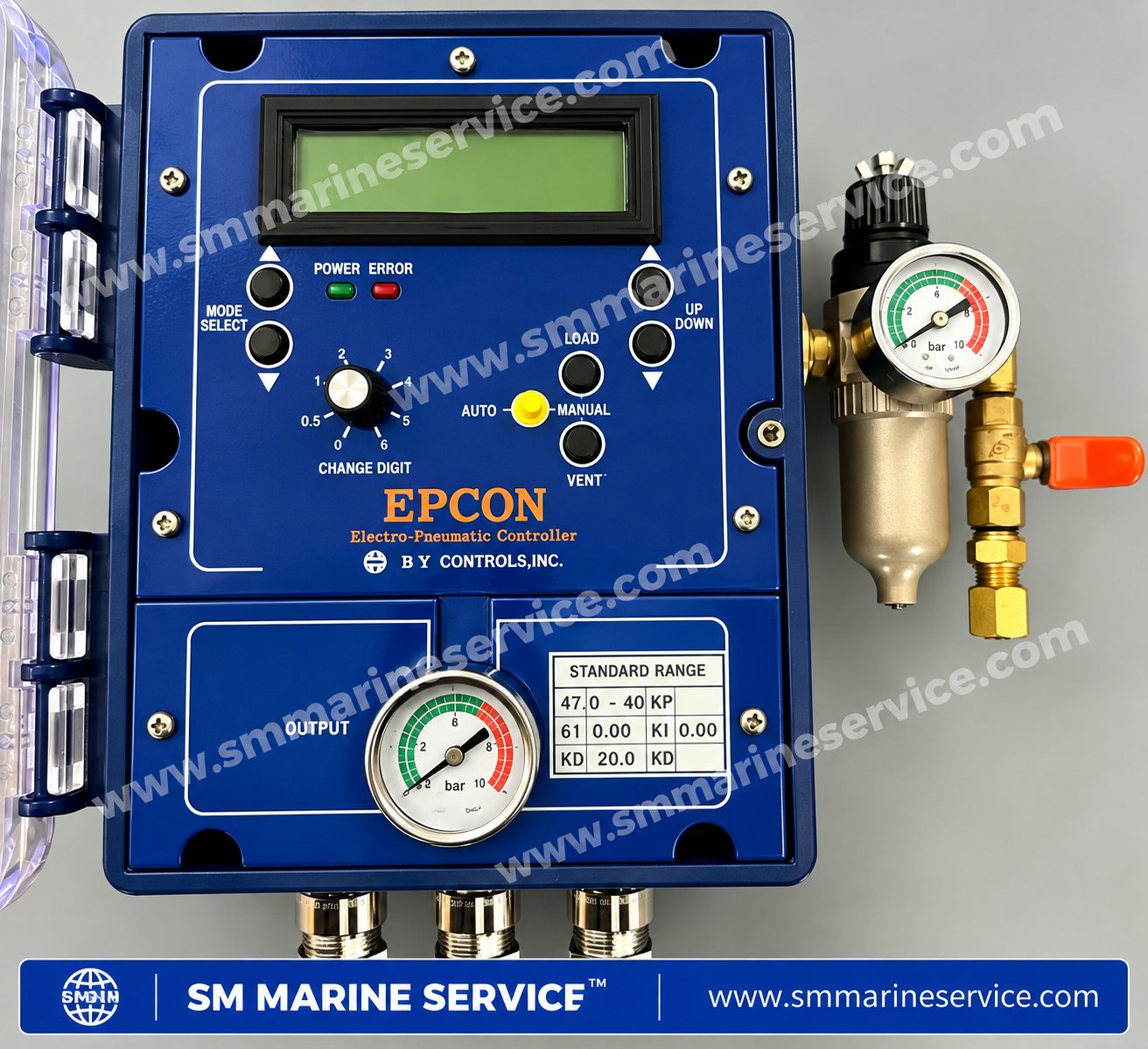
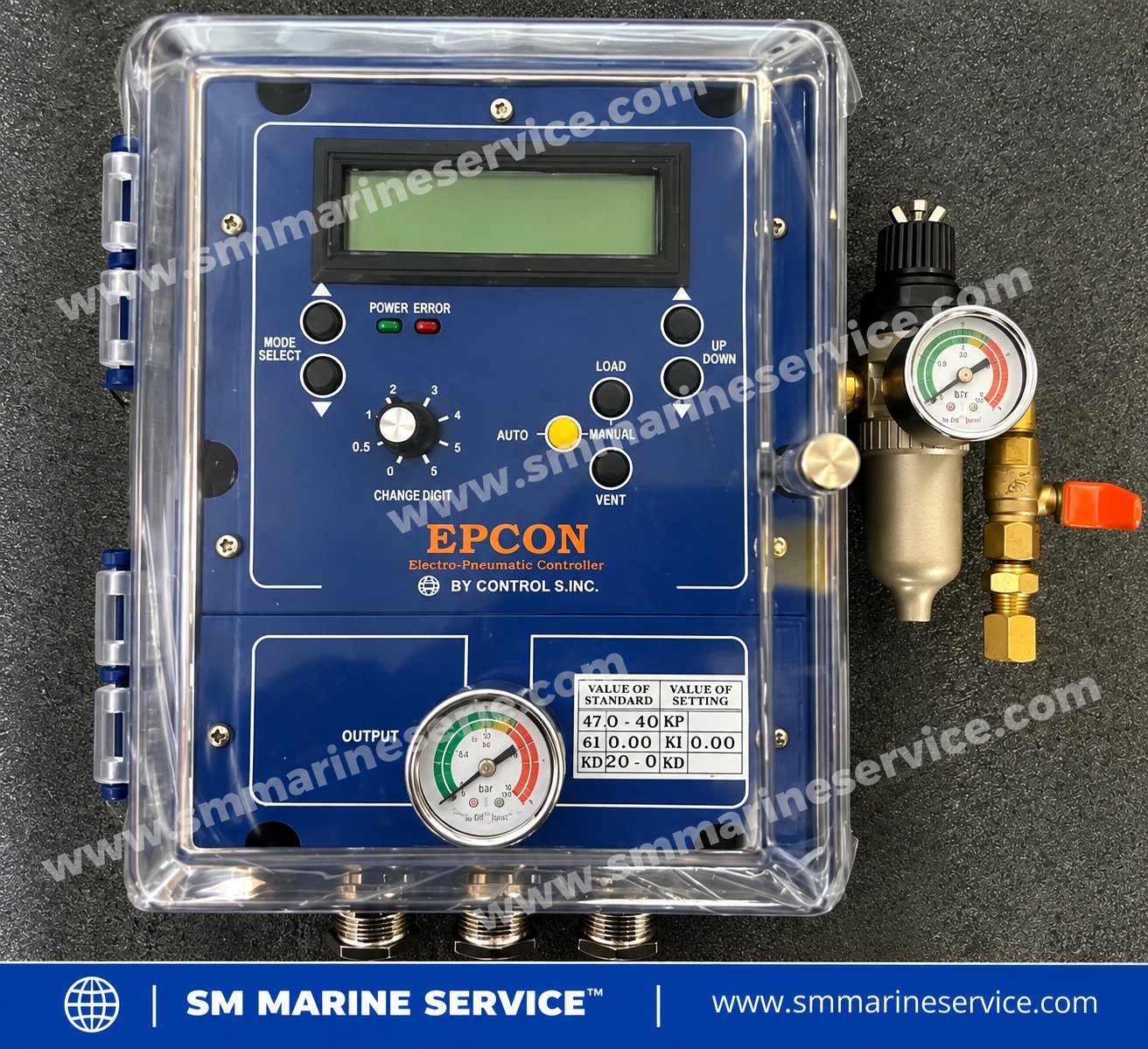
The photographs supplied by SM MARINE SERVICE™ also show an external filter/regulator and a dedicated output-pressure gauge.
Zero Air Consumption at Steady State
BY Controls states that EPCON consumes zero air at steady-state condition.
This is useful in shipboard pneumatic systems because control-air consumption is minimized when the controlled process has stabilized.
EPCON in Main Engine Jacket Cooling Water Control
A very important marine application is:
Main Engine Jacket Cooling Water Temperature Control
Marine maintenance records specifically describe using an EPCON E/P valve controller for main-engine jacket cooling-water temperature-control systems.
A vessel operating document also describes an electro-pneumatic temperature-control valve controlled by EPCON, with PID control performed directly by the EPCON unit.
This makes the following commercial search terms highly valuable:
M/E JCW EPCON
Main Engine Jacket Water Temperature Controller
EPCON Jacket Cooling Water Controller
EPCON W-14V / TR Series Application
Marine spare documentation identifies:
W-14V
in association with:
EPCON-1 Rev 2.5
and
DWG NO. BYAD 020
for Main Engine Jacket Cooling Water Temperature Control, used with a BY Controls TR Series control valve.
This does not mean W-14V is the universal EPCON model—it is an application/valve reference and should be matched to the vessel documentation.
FO Purifier Heater Temperature Controller
EPCON is also widely installed for:
FO Purifier Heater Temperature Control
Marine spare listings describe EPCON-1 as:
FO Purifier Heater Temperature Controller
and identify BYAD 020 PCB/drawing references for this application.
This is one of the most important alternate buyer search names for the controller.
Fuel Oil Separator Temperature Control
Another listing describes EPCON as:
Temperature Controller – HFO Heater / HFP Purifier
and
Electro-Pneumatic Controller Complete for Fuel Oil Separator
with 4–20mA / RTD control signal input.
Therefore:
Fuel Oil Separator Temperature Controller
and
Purifier Steam Control Valve Controller
are technically relevant SEO terms.
Main Engine Lube Oil Temperature Control
Marine spare documentation also records BYAD 020 PCB/control references for:
Main Engine Lube Oil Temperature Control.
This expands the marine use of EPCON beyond jacket cooling water and purifier heaters.
Central Cooler Temperature Control
Another BY Controls spare reference identifies BYAD 020 for:
Central Coolers
temperature-control applications.
This is useful because vessel engineers may search:
Central Cooler EPCON
rather than by the controller's official model.
Temperature & Pressure Controller
Marine-market references also list EPCON simply as:
Temperature and Pressure Control / Controller.
This naming is appropriate because the controller can accept standard analogue inputs and run PID control for different process variables.
China & Hong Kong Search Naming
I specifically checked how Chinese-market suppliers describe this equipment.
China-based suppliers commonly retain the English model but describe it functionally as:
EPCON-1 Electro-Pneumatic Controller
or
BY CONTROLS EPCON Electro-Pneumatic Controller.
Useful Chinese-language buyer phrases therefore include:
电气气动控制器 – electro-pneumatic controller
船用温度控制器 – marine temperature controller
电气气动温度控制器 – electro-pneumatic temperature controller
船用EPCON控制器 – marine EPCON controller
I did not find reliable evidence that China or Hong Kong uses a completely separate official model name for EPCON. The main difference is usually functional description, not model designation.
EPCON-1 Revision 2.3
Marine-market listings document:
EPCON-1 Rev 2.3
as a BYS Controls electro-pneumatic controller.
EPCON-1 Revision 2.5
Documented marine references also show:
EPCON-1 Rev 2.5
with DWG No. BYAD 020.
EPCON-1 Revision 2.9
Rev 2.9 units are also widely found in the marine aftermarket.
Current listings identify:
BYS Controls EPCON-1 Rev 2.9 Electro-Pneumatic Controller.
These revisions should not automatically be assumed to be PCB-level interchangeable.
EPCON PCB 16203-A
One of the most valuable PCB search references I verified is:
PCB 16203-A
A marine spare listing identifies:
BYS EPCON-1 Electro-Pneumatic Controller Rev 2.5
with:
PCB 16203-A
and reference:
00 12 03-144.
These exact numbers should be included in SEO because a buyer may have only the PCB removed from the controller and search by the board marking rather than “EPCON”.
BYAD 020 PCB / Drawing Reference
Another very important search reference is:
BYAD 020
This appears repeatedly in EPCON-1 marine temperature-controller spare records, including:
FO Purifier Heater Temperature Controller
M/E Jacket Cooling Water Temperature Controller
Main Engine Lube Oil Temperature Controller
and other marine temperature-control installations.
Therefore BYAD 020 is a strong technical and commercial keyword.
However, it should not be described as exactly the same PCB as 16203-A unless the physical board/revision confirms that match.
Rev 2.9 PCB / AC-DC Converter References
A documented EPCON-1 Rev 2.9 PCB assembly includes:
T-02
FS10-24 AC-DC Converter
Input: AC 100–240V, 0.25A, 50/60Hz
Output: 24VDC, 0.45A
10014975
E227474.
These are useful spare-board search references but should be considered revision-specific references, not universal part numbers for every EPCON.
Front Panel Controls
The photographed EPCON provides a straightforward operator interface including:
LCD Display
POWER LED
ERROR LED
MODE SELECT
UP / DOWN
LOAD
VENT
AUTO / MANUAL
CHANGE DIGIT
and an output-pressure gauge.
This combination allows local monitoring, parameter setting, manual operation and system testing.
Display Parameters
Older EPCON manuals describe display/parameter modes including:
PV – Process Value
SP – Set Point
DEV – Deviation
as well as maximum, minimum, engineering unit and tuning parameters.
Self-Diagnostics
The EPCON manual documents:
Service Mode Display
Error LED
and
Error Message
as self-diagnostic features.
This helps differentiate an electronics/input fault from a purely pneumatic problem.
Optional Communication
Older manual documentation identifies optional:
RS232C Link Output Capability.
This should not be assumed present on every EPCON unless the hardware/version confirms the option.
Optional Alarm Relay
The manual also describes an optional alarm relay with:
N.C. or N.O.
configuration.
Again, this is version/option dependent.
Common Problems & Troubleshooting
EPCON Has No Display
Check:
incoming power supply
internal fuse
power supply PCB
AC-DC converter
PCB connectors
before replacing the complete controller.
For Rev 2.9 hardware, the internal converter may be a relevant diagnostic area depending on the actual board configuration.
POWER LED On but Controller Does Not Operate
Check:
Mode setting
sensor input
4–20mA loop
PT100 wiring
controller configuration
Error indication
A process-input fault can prevent normal control even when the controller powers up.
ERROR LED Is On
Enter the appropriate service/error mode and check the displayed error.
Possible causes can include:
sensor fault
input signal outside range
internal PCB fault
parameter/configuration issue
Do not adjust PID values simply to clear a hardware or input fault.
No Pneumatic Output
Check:
control-air supply
filter/regulator
internal pneumatic components
vent valve
output port
AUTO/MANUAL state
A failed pneumatic supply can make a healthy electronic controller appear defective.
Output Pressure Is Too Low
Verify inlet air pressure first.
The current manufacturer specification expects approximately 2.4 ± 0.1 bar input for the standard output range.
Also check for:
air leakage
blocked regulator/filter
internal valve problem
incorrect setpoint/control demand
Temperature Hunts Up and Down
Possible causes include:
incorrect KP/KI/KD tuning
sticky control valve
oversized valve
sensor noise
incorrect sensor location
pneumatic leakage
The EPCON manual specifically provides tuning guidance for overshoot and fluctuation.
Large Temperature Overshoot
Reduce aggressive proportional response according to the applicable tuning procedure.
Do not randomly change several PID parameters at once.
Record existing values before adjustment.
Control Valve Does Not Respond
Check whether output air changes when the controller demand changes.
If output pressure moves but the process valve does not, investigate:
actuator diaphragm
valve stem
mechanical linkage
control-air tubing
before condemning EPCON.
PT100 Reading Is Wrong
Check:
PT100 resistance
sensor wiring
terminal connections
cable damage
and confirm the EPCON input is configured for the correct sensor type.
4–20mA Signal Is Wrong
Check the loop using a calibrated current source or meter.
Determine whether the fault is from:
transmitter
wiring
controller input
or
power supply.
AUTO Mode Does Not Control Properly
Confirm:
PV
SP
control action
PID settings
and pneumatic output.
Incorrect DIRECT/REVERSE selection can make the valve drive in the wrong direction.
MANUAL Mode Works but AUTO Does Not
If manual pneumatic output works correctly, focus troubleshooting on:
process input
set point
PID calculation
control direction
rather than the actuator or air supply.
Maintenance Recommendations
Routine EPCON maintenance should include:
checking air quality and regulator condition
draining filter moisture
checking pneumatic leakage
checking PCB connectors
checking PT100/4–20mA signal accuracy
confirming PID settings
testing AUTO/MANUAL operation
verifying output gauge operation
A clean, dry control-air supply is especially important for long pneumatic-component life.
Important Replacement Checks
Before ordering a replacement EPCON or PCB, provide:
Manufacturer: BY Controls / BYS Controls
Model: EPCON / EPCON-1
Revision: Rev 2.3 / 2.5 / 2.9 or exact unit
PCB Marking: e.g. 16203-A
Drawing Number: e.g. BYAD 020
Power Supply: 110V / 220V / 24VDC / actual PCB input
Process Input: PT100 or 4–20mA
Application: JCW / FO Purifier / Lube Oil / Central Cooler / Pressure Control
Valve Model: TR / DP series or installed valve reference
Existing parameter values
Front and PCB photographs
This is important because the outer EPCON enclosure may look similar while internal electronics, power arrangements and application configuration can differ.
Spare Parts & Replacement Availability
SM MARINE SERVICE™ supports worldwide sourcing and supply of BY Controls EPCON / EPCON-1 Electro-Pneumatic Controllers and related marine temperature-control spare parts.
Depending on availability, equipment may be supplied as:
New / New Old Stock
Used Tested Working
Refurbished
Reconditioned
Typical requirements include:
Complete EPCON Controller
EPCON-1 Controller
EPCON PCB / Main Board
PCB 16203-A
BYAD 020 related PCB/assembly
Power Supply / AC-DC Converter
Display / Operator Components
Pneumatic Regulator Assembly
Solenoid / Vent Valve Components
Pressure Gauge
PT100 Temperature Sensor
BY Controls TR / DP Series Valve Components
For replacement enquiries, buyers should send clear photographs of both the controller front panel and internal PCB marking.
SM MARINE SERVICE™ also supports marine automation and control equipment through www.smmarineservice.com.
Why Ships Still Use EPCON
EPCON remains useful on many existing vessels because it combines:
digital PID control
with
direct pneumatic valve actuation
in a relatively simple standalone system.
Replacing the entire arrangement with a PLC, separate controller, I/P converter and new valve instrumentation may require:
rewiring
new control-air tubing
new logic
commissioning
and
process retuning.
Where the existing valve and process system remain healthy, repairing or replacing the EPCON or its PCB can be a practical option.
Frequently Asked Questions
What is EPCON?
EPCON is an Electro-Pneumatic Controller manufactured by BY Controls, Inc. It combines electronic process control with pneumatic valve output.
What does EPCON control?
It can control process variables such as temperature and pressure using P, PI or PID control.
Is EPCON used on ships?
Yes. BY Controls explicitly states marine use, and marine records document EPCON in jacket-water, purifier, lube-oil and other shipboard temperature-control systems.
Is EPCON also called a temperature controller?
Yes. Marine suppliers frequently list it as an Electro-Pneumatic Temperature Controller or application-specific temperature controller.
Is EPCON used for FO purifier temperature control?
Yes. Marine spare references specifically identify EPCON-1 as an FO Purifier Heater Temperature Controller.
Is EPCON used for main engine jacket cooling water?
Yes. EPCON is documented in marine jacket cooling-water temperature-control systems.
What is PCB 16203-A?
A marine spare listing identifies PCB 16203-A with an EPCON-1 Rev 2.5 controller.
What is BYAD 020?
BYAD 020 is a recurring drawing/PCB/application reference found on EPCON marine temperature-control spare documentation, including purifier and engine cooling applications.
Does every EPCON use PCB 16203-A?
No. Different revisions exist, including Rev 2.3, Rev 2.5 and Rev 2.9, and internal hardware must be checked before assuming interchangeability.
What supply voltage does EPCON use?
Current manufacturer data lists 110/220VAC 50/60Hz or 24VDC, depending on configuration.
What signal input does EPCON use?
The manufacturer lists 4–20mA and PT100 input capability.
What is the pneumatic output range?
Current manufacturer specifications give approximately 0.4–2.0 bar / 6–30 psi.
Does EPCON require an I/P converter?
BY Controls documentation says EPCON does not require a separate positioner and I/P converter in the standard application.
What does KP, KI and KD mean?
They are the proportional, integral and derivative tuning parameters used by the PID controller.
Can EPCON control pressure as well as temperature?
Yes. The controller supports process-control applications and marine suppliers list EPCON for both temperature and pressure control.
Is EPCON made in Korea?
Yes. BY Controls is based in Gimhae, Republic of Korea, and documented EPCON units are listed as Korean manufacture.
Where can I buy an EPCON controller or PCB?
SM MARINE SERVICE™ supports worldwide supply of complete EPCON controllers, used/tested units, PCB assemblies and related marine temperature-control spares, subject to availability.
Short Product Description
BY Controls EPCON / EPCON-1 Electro-Pneumatic Controller is a digital marine and industrial process controller used for temperature, pressure and pneumatic control-valve applications. It supports PT100 and 4–20mA inputs, P/PI/PID control, Direct/Reverse action, local and remote set point adjustment, electronic display and controlled pneumatic output. Marine applications include FO purifier heater temperature control, fuel-oil separator control, main-engine jacket cooling-water temperature control, main-engine lube-oil temperature control and central-cooler control. Important replacement/search references include EPCON-1 Rev 2.3 / Rev 2.5 / Rev 2.9, PCB 16203-A and DWG BYAD 020, but hardware revisions should be verified before replacement. SM MARINE SERVICE™ supplies complete EPCON controllers, PCBs and related marine automation spare parts worldwide.
SM MARINE SERVICE™
Marine Automation & Navigation Equipment Supplier
Available Condition:
• New Equipment • Used Equipment • Refurbished Equipment • Reconditioned Equipment
Stock Location:
• Bangladesh • China
Services:
• Worldwide Shipping • Technical Support • Spare Parts Supply • Marine Equipment Sourcing
Contact Information
SM MARINE SERVICE™ Samir Market, DT Road, Pahartali, beside CDA Market, Chattogram, Bangladesh
Mobile / WhatsApp / Viber: +88 01818 929292
Email: info@smmarineservice.com
Website: www.smmarineservice.com