Engine O-WACS-100DI-5M Water in Oil Monitoring System
Hanwha Engine / former HSD Engine / Doosan Engine
New product
The Hanwha Engine O-WACS-100DI-5M Water in Oil Monitoring System is a continuous marine engine condition-monitoring system designed to detect water contamination in lubricating oil.
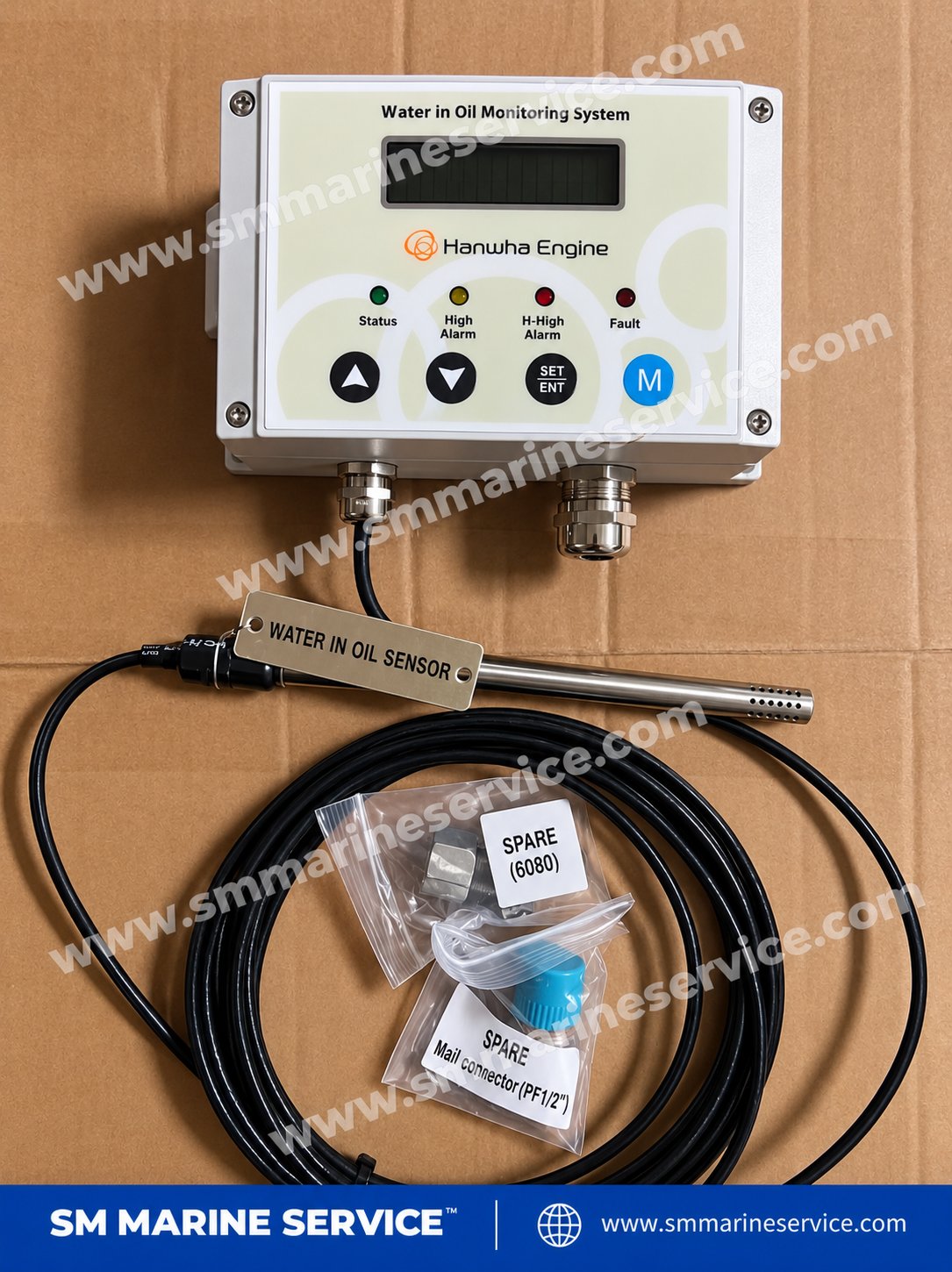
The photographed SM MARINE SERVICE™ unit consists of a dedicated Water in Oil Monitoring System control/display unit, a stainless-steel Water in Oil Sensor, connecting cable and spare installation fittings.
Current Hanwha main-engine specifications identify O-WACS as Hanwha Engine’s Water in Oil system for monitoring main lubricating oil, with alarm output to the engine monitoring/protection system.
The same product family can also be found in the marine aftermarket under the former company names HSD Engine and Doosan Engine, particularly with the exact designation O-WACS-100DI-5M.
Manufacturer / System Family: Hanwha Engine / former HSD Engine / Doosan Engine
System: O-WACS
Model: O-WACS-100DI-5M
Product Type: Water in Oil Monitoring System
Sensor Description: Water in Oil Sensor / Humidity & Temperature Transmitter
Application: Main Engine Lubricating Oil Monitoring
Alarm Indications: High Alarm / H-High Alarm / Fault
Display: Integrated digital display
Sensor Construction: Stainless-steel insertion probe
Related Search Reference: 126770
Country: Korea
Market records for the exact model identify it as O-WACS-100DI-5M Humidity & Temperature Transmitter / Water in Oil Monitoring System, with reference 126770 appearing on documented units.
O-WACS is a water-content monitoring system for lubricating oil.
The O-WACS WIO manual describes it as equipment for continuous measurement of water content in oil, with installation, operation, maintenance, calibration and alarm handling functions.
Unlike traditional periodic oil sampling, an online sensor provides continuous indication of changing moisture conditions while the engine remains in operation.
This helps the crew identify increasing water contamination before severe oil degradation or lubrication problems develop.
Water contamination can seriously affect marine diesel-engine lubricating oil.
Excess water can contribute to:
This is why modern engine-monitoring systems increasingly include dedicated Water in Oil measurement alongside bearing-wear and bearing-temperature monitoring.
Kongsberg, for example, also categorizes water-in-oil measurement as part of its marine engine condition-monitoring portfolio, emphasizing continuous moisture detection in oil.
One of the most important technical concepts behind Water in Oil monitoring is water activity, commonly written as:
aw
Water activity indicates how close the oil is to its water-saturation point.
As the oil approaches saturation, the risk of free water formation increases.
The O-WACS documentation identifies the control unit as displaying water content in aw – Water Activity units.
This is important because dissolved water may already be increasing significantly before visible free water appears in the oil.
The O-WACS Sensor Unit is installed directly in the engine lubricating-oil system.
The manual states that the sensor is installed at the main lubricating-oil inlet pipe of the engine and detects moisture using an internal humidity sensor.
The sensor sends measurement information to the control/display unit, where the data is processed and displayed.
The photographed probe has a stainless-steel sensing section designed for insertion into the oil stream.
Hanwha engine specifications list:
Water In Oil System – Hanwha Engine O-WACS
with the applying point identified as:
Main Lube Oil.
The same engine instrument list identifies:
Water in lub. oil – XS8150 – Alarm / Slowdown
as a monitored main-engine condition.
This makes the strongest application keywords:
Main Engine Water in Oil Sensor
Main Lube Oil Moisture Monitor
Marine Engine Oil Water Detector
Main Engine Oil Condition Monitor
The photographed control unit provides:
LCD display
and four clear operating indicators:
Status
High Alarm
H-High Alarm
Fault
along with:
UP
DOWN
SET / ENT
M
controls.
The O-WACS manual states that the control/display unit calculates information received from the system, shows measured values on the LCD and provides relay outputs.
The yellow High Alarm indication provides an early warning that moisture/water activity has risen above the configured alarm level.
This gives the engineering crew an opportunity to investigate the source of water contamination before conditions become more serious.
Possible causes can include:
cooling-water leakage
purifier/separator problems
condensation
oil cooler leakage
other lube-oil system contamination
The actual cause should be investigated rather than simply resetting the alarm.
The red H-High Alarm is the higher-stage alarm.
This represents a more critical water-content condition than the normal High Alarm.
The exact threshold values should follow the applicable O-WACS settings and engine-maker requirements.
Engine configuration documentation may use the signal for alarm and potentially slowdown logic depending on vessel/engine design.
The dedicated Fault LED indicates system or sensor malfunction rather than simply high water content.
Possible fault areas can include:
sensor failure
cable fault
connection problem
communication failure
control-unit problem
A Fault indication therefore needs a different troubleshooting approach from a genuine High Water alarm.
Competitors and spare-parts suppliers frequently call O-WACS-100DI-5M a:
Humidity & Temperature Transmitter
rather than only “Water in Oil Sensor.”
This is an important SEO phrase because technical buyers may search the unit using the name printed on its sensor/transmitter documentation rather than the complete O-WACS system name.
Therefore the page should naturally target both:
Water in Oil Monitoring System
and
Humidity & Temperature Transmitter.
The designation:
100DI-5M
is also important in buyer searches.
Exact marine listings consistently use O-WACS-100DI-5M rather than simply O-WACS.
The “5M” designation should therefore remain intact in all SEO titles, RFQs and replacement searches rather than being removed.
The O-WACS WIO manual states that the control unit supports:
RS485 serial communication.
This allows system data to be communicated to compatible monitoring/automation equipment.
Useful search terms include:
O-WACS RS485
Water in Oil Monitor RS-485
Marine Oil Moisture Sensor Communication
The O-WACS manual also states that, when the optional analogue-output board is installed, both:
water activity (aw)
and
temperature
can be transmitted as 4–20mA signals.
This enables remote indication through a vessel monitoring system.
Because it is an optional board, a 4–20mA output should not be assumed for every O-WACS unit without checking the hardware.
The control/display unit can provide relay outputs associated with monitored conditions.
This permits integration with the ship’s:
Alarm Monitoring System
Engine Safety System
Integrated Automation System
depending on the installed configuration.
Current Hanwha specifications explicitly identify O-WACS as providing an alarm signal.
Today the product is best optimized under the keyword:
Hanwha Engine O-WACS
because current Hanwha engine specifications use this name.
However, the same engineering heritage appears under previous company names.
This is crucial for SEO.
Many existing vessel units are labelled:
HSD ENGINE
and exact competitor listings describe:
HSD ENGINE O-WACS-100DI-5M HUMIDITY & TEMPERATURE TRANSMITTER.
Therefore HSD Engine O-WACS should remain a major keyword.
Earlier units are also widely found under:
DOOSAN ENGINE
with exact replacement listings identifying:
DOOSAN O-WACS-100DI-5M HUMIDITY & TEMPERATURE TRANSMITTER / WATER IN OIL MONITORING SYSTEM.
For older vessels, the crew may know only the Doosan name.
Therefore a strong product page should intentionally target:
Hanwha Engine
HSD Engine
and
Doosan Engine
without falsely suggesting three different systems.
Hanwha engine documentation also lists:
B-WACS – Bearing Wear Monitoring System
alongside:
O-WACS – Water in Oil System.
These are related engine condition-monitoring systems.
However:
B-WACS and O-WACS are not the same equipment.
B-WACS is used for bearing-wear monitoring, while O-WACS is used for oil moisture/water monitoring.
This distinction is useful for both engineers and search engines.
An HSD Engine service brochure also lists:
Multi OWACS (Water In-Oil)
and
O-WACS (Water In-Oil)
among its engine condition-monitoring/service products.
Therefore Multi O-WACS is a valid related search term for the broader Hanwha/HSD water-in-oil product family.
It should not automatically be treated as identical hardware to O-WACS-100DI-5M.
Hanwha engine specifications also mention alternative Water in Oil suppliers including:
Dr. E. Horn
and
Kongsberg
depending on project specification.
These competitor systems help explain buyer searches such as:
O-WACS replacement
Water in Oil Sensor replacement
MAN engine WiO sensor
but they should not be described as plug-and-play substitutes without technical verification.
Traditional oil analysis often depends on a sample being manually taken and sent for testing.
Continuous Water in Oil monitoring provides a different benefit:
real-time indication of changing water contamination
while the engine remains operating.
This allows engineers to recognize an abnormal trend sooner.
Kongsberg describes the same operational benefit for its own water-in-oil technology: continuous moisture measurement can be used for ongoing machinery protection and condition monitoring.
An O-WACS alarm should be treated as a condition requiring investigation.
Possible sources include:
The monitor indicates the water condition; it does not itself determine the physical leak source.
Check:
power supply
terminal connections
fuses
sensor/controller cabling
before replacing the display unit.
If the correct supply is present but the system remains inactive, internal diagnosis may be necessary.
Check:
sensor connector
sensor cable
probe
communication wiring
and the controller configuration.
A Fault alarm should not be confused with a genuine high-water alarm.
First verify whether the oil actually contains water.
Take an independent oil sample if appropriate.
Then investigate the lubrication system for possible water ingress.
Do not recalibrate the monitor simply to make a genuine high reading disappear.
Inspect the main lube-oil system for contamination and review the measured water activity.
If the alarm rises gradually, it may indicate worsening oil condition or an increasing contamination source.
Treat this as a more severe condition than the normal High Alarm.
Follow the vessel’s engine-maker procedures and safety logic.
Do not repeatedly reset the alarm without determining the source.
Check:
probe installation
oil flow condition
connector tightness
sensor contamination
cable condition
The sensor should be installed in the correct oil-flow location.
Check:
communication polarity
cable continuity
termination
controller address/settings
associated automation-system interface
before replacing the O-WACS controller.
First verify that the optional analogue-output board is actually installed.
The O-WACS manual describes 4–20mA as an option, not necessarily a standard output on every unit.
The manual states that the Sensor Unit is installed at the main lube-oil inlet pipe, with the sensing section exposed to the oil.
Correct installation is important because poor positioning may affect measurement.
The sensor should be installed according to the engine/O-WACS documentation rather than simply placed at any convenient location in the lubrication circuit.
Water-in-oil measurement should be periodically checked according to the manufacturer's calibration procedure.
The O-WACS manual includes a dedicated:
Calibration
section and a Calibration Certificate section.
Calibration history is especially important when evaluating a used or refurbished sensor.
Before ordering an O-WACS replacement, provide:
System: O-WACS
Model: O-WACS-100DI-5M
Brand on original unit: Hanwha / HSD / Doosan
Sensor model/reference
Control unit photo
Sensor photo
Cable length
Connector type
Existing serial/reference number
Main engine model
Required quantity
Because multiple O-WACS generations exist, matching only the words “Water in Oil Sensor” is not enough.
SM MARINE SERVICE™ supports worldwide supply and sourcing of Hanwha Engine / HSD / Doosan O-WACS Water in Oil Monitoring Systems and marine engine condition-monitoring spares.
Depending on current stock, equipment may be available as:
New / New Old Stock
Used Tested Working
Refurbished
Reconditioned
Potential requirements include:
O-WACS-100DI-5M Complete System
Water in Oil Sensor
Control / Display Unit
Sensor Cable
Installation Fittings
O-WACS related monitoring components
SM MARINE SERVICE™ already lists the exact product family under Hanwha Engine O-WACS-100DI-5M Water in Oil Monitoring System in its marine automation catalogue.
Water contamination in main-engine lubricating oil remains a critical machinery condition regardless of vessel age.
Continuous water-in-oil monitoring can help detect deterioration before visible free water or severe lubrication problems occur.
Hanwha continues to specify O-WACS within its main-engine condition-monitoring options, while the HSD service catalogue also lists O-WACS among supported engine-monitoring products.
For existing ships, replacing a failed sensor or display can therefore be far more practical than removing the complete monitoring arrangement.
O-WACS is Hanwha Engine’s Water in Oil Monitoring System for monitoring moisture/water content in main-engine lubricating oil.
It is an exact O-WACS model widely listed as a Humidity & Temperature Transmitter / Water in Oil Monitoring System.
Yes. The system uses a dedicated Water in Oil sensor installed in the lubricating-oil circuit.
Yes. Exact O-WACS-100DI-5M market listings use the description Humidity & Temperature Transmitter.
The WIO-series documentation describes measurement of water content expressed as water activity – aw, together with temperature-related monitoring capability.
The O-WACS manual identifies the main-engine lubricating-oil inlet pipe as the sensor installation location.
The photographed system has separate High Alarm and H-High Alarm indicators together with Status and Fault LEDs.
Yes. RS485 serial communication is documented in the O-WACS manual.
An optional analogue-output board can provide 4–20mA signals for water activity and temperature.
Yes. Exact O-WACS-100DI-5M units are widely documented under HSD Engine branding.
Yes. Earlier units are documented as Doosan O-WACS-100DI-5M.
Marine-market listings associate 126770 with O-WACS-100DI-5M humidity/temperature transmitter and Water in Oil Sensor units.
No. Hanwha documentation identifies B-WACS as Bearing Wear Monitoring and O-WACS as Water in Oil monitoring.
SM MARINE SERVICE™ supports worldwide sourcing and supply of Hanwha/HSD/Doosan O-WACS Water in Oil Monitoring Systems, sensors and related marine engine monitoring spare parts, subject to availability.
Hanwha Engine O-WACS-100DI-5M Water in Oil Monitoring System is a marine main-engine lubricating-oil condition-monitoring system used to continuously detect moisture/water contamination. The system is also widely found under former HSD Engine and Doosan Engine branding and is commonly searched as a Water in Oil Sensor, Humidity & Temperature Transmitter, Water Activity Monitor and Oil Moisture Detector. O-WACS provides LCD indication, Status, High Alarm, H-High Alarm and Fault monitoring, with RS-485 communication and optional 4–20mA output documented in the WIO system manual. SM MARINE SERVICE™ supplies complete O-WACS systems, sensors and related marine engine condition-monitoring spare parts worldwide.
SM MARINE SERVICE™
Marine Automation & Navigation Equipment Supplier
Available Condition:
• New Equipment • Used Equipment • Refurbished Equipment • Reconditioned Equipment
Stock Location:
• Bangladesh • China
Services:
• Worldwide Shipping • Technical Support • Spare Parts Supply • Marine Equipment Sourcing
Contact Information
SM MARINE SERVICE™ Samir Market, DT Road, Pahartali, beside CDA Market, Chattogram, Bangladesh
Mobile / WhatsApp / Viber: +88 01818 929292
Email: info@smmarineservice.com
Website: www.smmarineservice.com
0

BDT 0

BDT 0

BDT 0

BDT 0
Marine Equipment Supplier