Bently Nevada 3500 Machinery Protection System
Bently Nevada (now part of Baker Hughes)
Refurbished
Bently Nevada (now part of Baker Hughes)
United States
Modular Machinery Protection and Condition Monitoring System
Continuous vibration, shaft position, seismic, alarm, relay, and machinery health monitoring for marine rotating equipment such as turbochargers, compressors, pumps, motors, generators, turbines, and other critical machinery
The Bently Nevada 3500 System is one of the most recognized machinery protection and condition monitoring platforms used worldwide for critical rotating equipment. In marine and offshore environments, it is especially valued where ship operators, technical superintendents, and engine room teams need continuous monitoring of vibration, shaft behavior, transducer inputs, alarm conditions, and machinery health from high-value rotating assets.
Unlike a simple vibration indicator, the 3500 system is a complete rack-based protection platform. It combines power supply modules, communication modules, vibration monitoring modules, relay modules, and expansion capability into a single machinery protection architecture. This makes it suitable for installations where machinery shutdown protection, alarm output, condition monitoring, and integration with other control systems are all required from one dependable monitoring system.
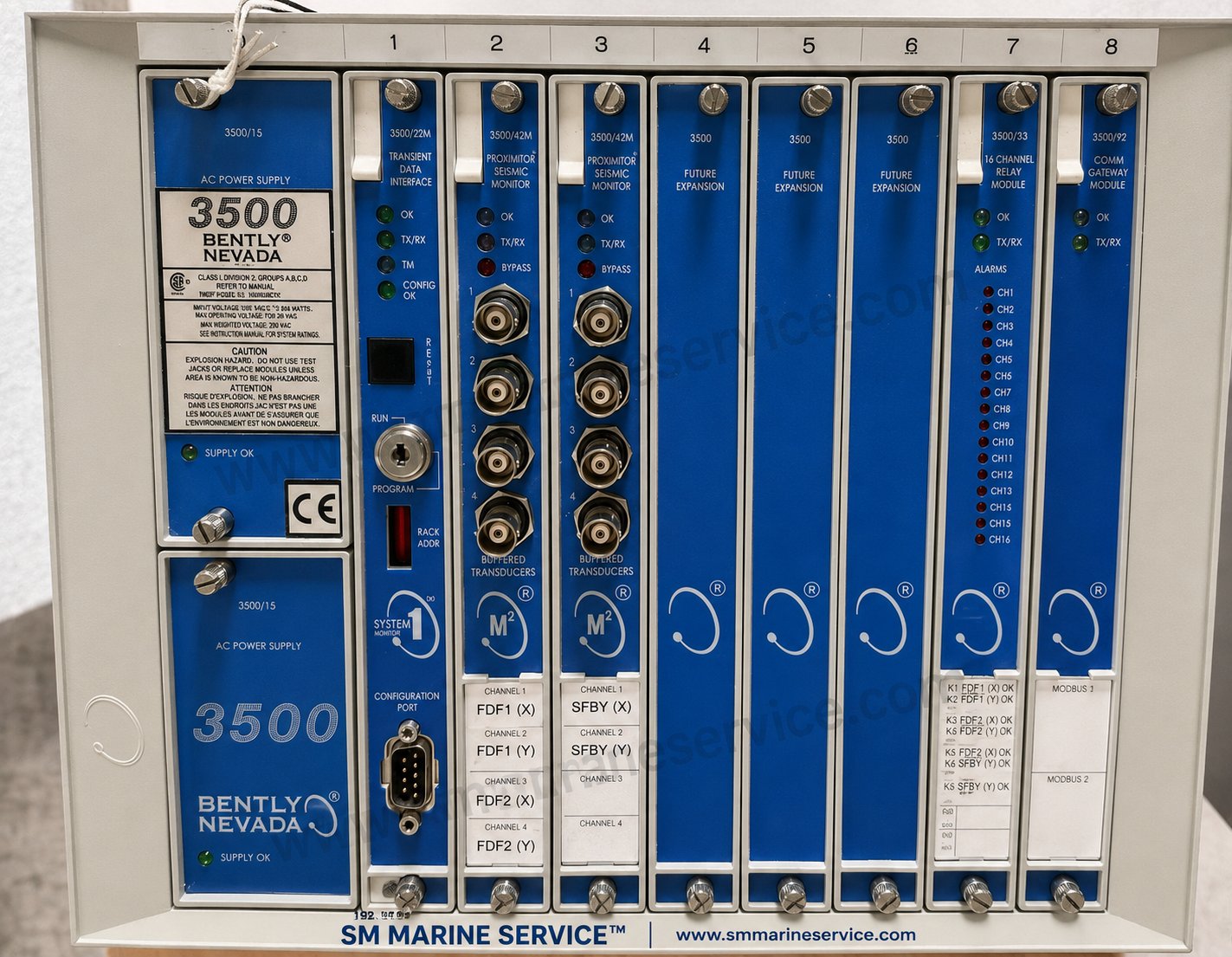
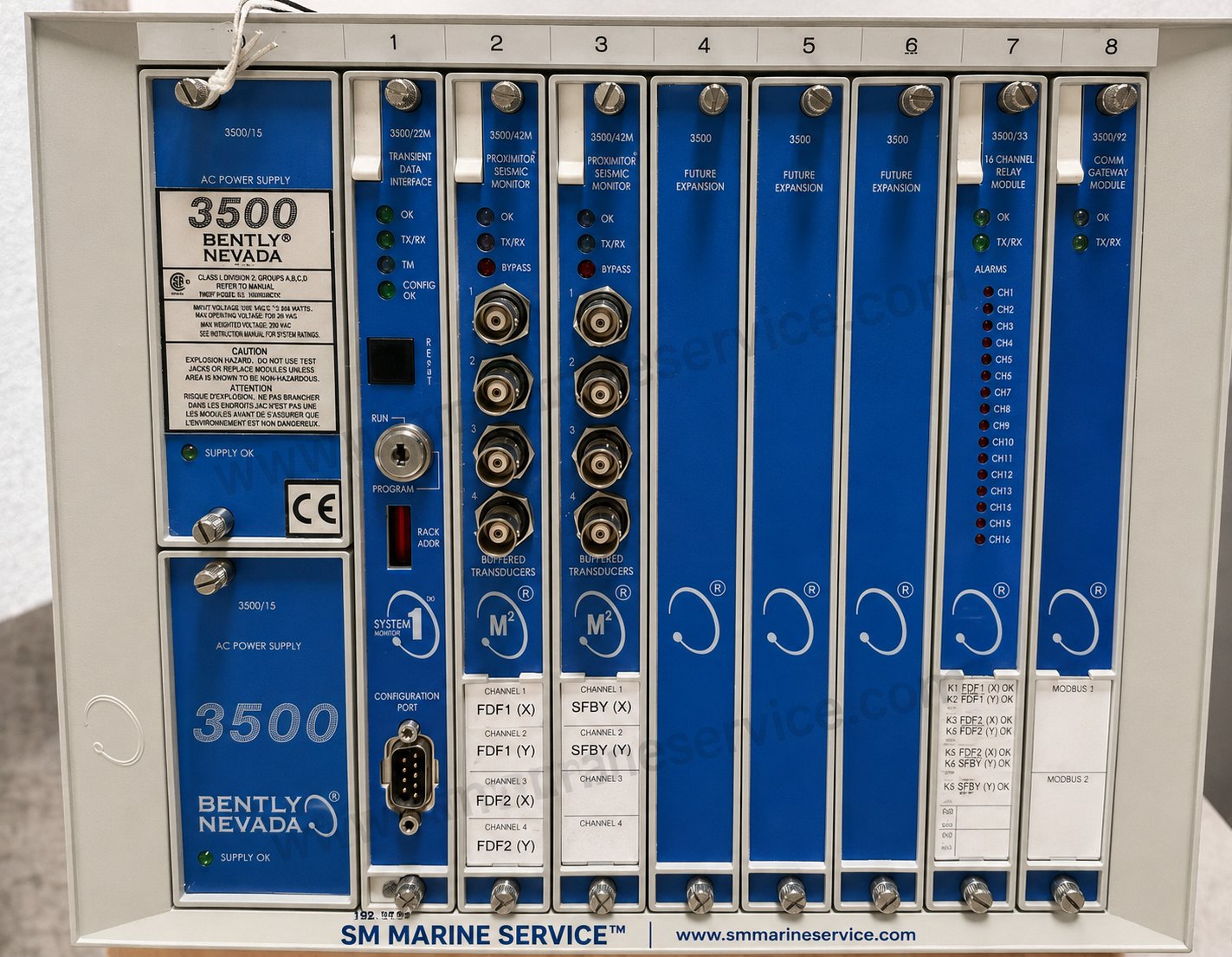
The rack shown in your product image includes a practical combination of modules typically seen in industrial and marine monitoring applications, including:
For ships operating critical rotating equipment, systems like this are not only used for monitoring—they are often part of the machinery protection philosophy of the vessel or plant.
The Bently Nevada 3500 is a rack-mounted machinery protection system designed to accept signals from different transducers and monitoring channels, process those signals in real time, compare them with configured alarm or danger setpoints, and trigger alarms, relays, shutdown outputs, or communication events when machinery conditions move outside safe operating limits.
In simple practical marine terms, the 3500 system acts as the central monitoring and protection brain for important rotating equipment. It can continuously watch parameters such as:
This is why the 3500 system is often found wherever rotating machinery failure would be expensive, dangerous, or operationally critical.
Based on the supplied image, the rack includes a configuration centered around several important modules. Below is a practical explanation of each one.
The 3500/15 provides the rack with operating power. The power supply is a critical foundation module because the rest of the system depends on stable internal power distribution for monitor modules, communication interfaces, and relay logic.
The 3500/22M TDI acts as the system interface between the rack and external configuration / data systems. It is commonly used for configuration, data collection, rack addressing, and communication with monitoring software or plant systems. In many installations, the TDI is the key communication point for the entire rack.
The 3500/42M is one of the most widely used monitor modules in the 3500 family. It accepts inputs from proximity probes and seismic transducers and converts those signals into machinery protection and condition monitoring information. Depending on configuration, it can monitor vibration, position, and other related dynamic machine conditions.
In your rack image, the presence of multiple 3500/42M modules indicates that this system was configured to monitor multiple channels or multiple machine points.
The 3500/33 relay module is used to generate relay outputs based on alarm or trip logic. These relays can be tied to annunciation, shutdown systems, warning panels, machinery interlocks, or external control logic. For marine or industrial applications, relay output capability is extremely important because a monitoring system becomes far more useful when it can actually trigger alarm actions or protective responses.
The 3500/92 communication gateway provides external communication support and can help the rack share data with other control or monitoring systems. In practice, this is important when the 3500 rack needs to interface with broader automation or plant monitoring networks.
The blank slots labeled as future expansion show one of the strongest advantages of the 3500 platform: modular scalability. A shipowner or plant operator can expand the rack later by adding additional monitor modules, communication modules, or system functions depending on machinery monitoring requirements.
The Bently Nevada 3500 system has remained widely used because it combines protection, monitoring, modularity, and industrial reliability in one platform.
The system continuously monitors machinery condition rather than relying on periodic manual inspection. This allows abnormal vibration or position trends to be identified early.
Because the 3500 system uses separate dedicated modules, the rack can be configured according to the machine and the application. This makes it suitable for small single-machine installations as well as larger integrated monitoring packages.
Depending on the installed monitor module, the 3500 platform can accept signals from proximity probes, seismic sensors, and other machinery transducers used for protection and condition monitoring.
The system does not only display information—it can compare measured values with programmed alarm thresholds and trigger relays, warnings, or shutdown responses when machinery conditions exceed safe limits.
Modules such as the 3500/22M and 3500/92 allow the system to communicate with external software, supervisory monitoring systems, or integrated control environments.
The 3500 family has been widely used on turbines, compressors, generators, motors, and other machinery where machine failure could lead to major operational or financial loss.
A complete Bently Nevada 3500 installation generally consists of more than just the rack itself. A working marine machinery protection arrangement may include the following:
This includes the physical 3500 rack with power supply, TDI, monitor modules, relay modules, communication modules, and optional expansion modules.
Depending on the machine being monitored, the system may be connected to:
All transducer signals and alarm outputs must be properly wired back to the rack. Signal integrity is very important because vibration monitoring systems are only as good as the quality of their measurement inputs.
Relay outputs from the rack may be connected to alarm annunciation panels, machinery shutdown logic, PLCs, DCS interfaces, or other automation systems.
The rack typically requires proper configuration using Bently Nevada tools or compatible support systems. Configuration defines alarm setpoints, channel type, logic, scaling, relay assignments, and communication parameters.
Although Bently Nevada systems are widely known in oil & gas, power generation, and industrial plants, the same protection philosophy is highly relevant in marine and offshore service. On ships and marine facilities, the 3500 system may be used for:
Turbochargers operate at high speed and can be highly sensitive to vibration and bearing issues. Monitoring helps detect developing faults before catastrophic damage occurs.
On offshore vessels, gas-related systems, or specialized marine plants, compressors often require continuous vibration protection.
Vibration monitoring can help protect generator sets, large alternator-driven systems, or critical support machinery where mechanical condition directly affects vessel power reliability.
Main cargo pumps, process pumps, or other mission-critical rotating equipment can benefit from continuous vibration and condition monitoring.
Where steam or gas turbine equipment is installed, machinery protection systems become especially important because turbine damage can be severe and expensive.
Any high-value rotating asset operating under continuous load, variable load, or critical duty cycle may justify installation of a system like the 3500.
The 3500 system is known for reliability, but in real service conditions, engineers may face a number of practical problems. Below are some common field-level issues to consider.
Possible causes
Troubleshooting
Possible causes
Troubleshooting
Possible causes
Troubleshooting
Possible causes
Troubleshooting
Possible causes
Troubleshooting
For shipboard or offshore applications, the Bently Nevada 3500 system should be treated as critical protection equipment rather than as a simple accessory. Good maintenance practice includes the following:
Salt-laden air, engine room contamination, and moisture can affect long-term reliability. Rack cabinets should be kept clean, dry, and protected from unnecessary contamination.
Many “system problems” are actually field wiring or sensor problems. Inspect cable integrity, gland sealing, and connector tightness at scheduled intervals.
Whenever machinery is overhauled, sensors are changed, or modules are replaced, configuration should be checked carefully to ensure the monitoring logic still matches the actual machine.
Where relays are used for alarm or shutdown logic, periodic function testing is advisable to confirm that the protection chain still works correctly.
Keep module list, rack configuration, channel mapping, sensor type, and alarm settings documented. This is especially important when a vessel changes crew or when troubleshooting is carried out under time pressure.
For a system like the 3500, it is good practice to keep critical spares such as monitor modules, power supply modules, or communication modules available where the machinery is essential to operations.
The reason many operators continue to use the Bently Nevada 3500 platform is straightforward: it is a proven, modular, industrial-grade machinery protection system built for serious rotating equipment monitoring.
Ships and offshore operators continue to value the 3500 because it offers:
For marine operators with high-value rotating assets, a dependable monitoring platform can help reduce unplanned downtime, support predictive maintenance, and prevent severe machinery damage.
It is used for machinery protection and condition monitoring of rotating equipment such as turbines, compressors, pumps, motors, and generators by monitoring vibration, position, and other machinery health signals.
Yes. Although widely used in industrial plants and power facilities, the same machinery protection principles make it highly suitable for marine and offshore rotating equipment monitoring.
The 3500/42M Proximitor / Seismic Monitor accepts signals from proximity and seismic transducers and processes them for machinery protection and condition monitoring purposes.
The 3500/33 provides relay outputs that can be assigned to alarms, trips, annunciation, shutdown logic, or other external control functions.
The 3500/22M Transient Data Interface is a key interface module for rack configuration, data communication, and system integration.
Yes. SM MARINE SERVICE™ can support sourcing for Bently Nevada 3500 system modules, marine vibration monitoring equipment, machinery protection spare parts, and related automation equipment subject to stock and availability.
The Bently Nevada 3500 Machinery Protection System is a modular rack-based monitoring and protection platform used for critical rotating equipment vibration monitoring, transducer signal processing, alarm generation, relay output, and machinery health protection. It is widely used in industrial and marine environments for compressors, turbines, pumps, generators, motors, and other important rotating machinery requiring continuous condition monitoring and protection.
Available Condition:
• New Equipment • Used Equipment • Refurbished Equipment • Reconditioned Equipment
Stock Location:
• Bangladesh • China
Services:
• Worldwide Shipping • Technical Support • Spare Parts Supply • Marine Equipment Sourcing
SM MARINE SERVICE™
Samir Market, DT Road, Pahartali, beside CDA Market,
Chattogram, Bangladesh.
Mobile / WhatsApp / Viber: +88 01818 929292
Email: info@smmarineservice.com
Website: www.smmarineservice.com
0
BDT 0
BDT 0
BDT 0
BDT 0
Marine Equipment Supplier