Engine Control Module
Wärtsilä
Refurbished
Manufacturer: Wärtsilä / Sulzer RT-flex platform
Country of Origin: Switzerland / Finland system heritage (RT-flex platform)
Product Type: Flex Control Module (FCM-20) for Electronic Main Engine Control
Marine Application: RT-flex two-stroke low-speed main engine common rail control, fuel injection control, exhaust valve actuation, start valve control, and WECS-9520 engine automation
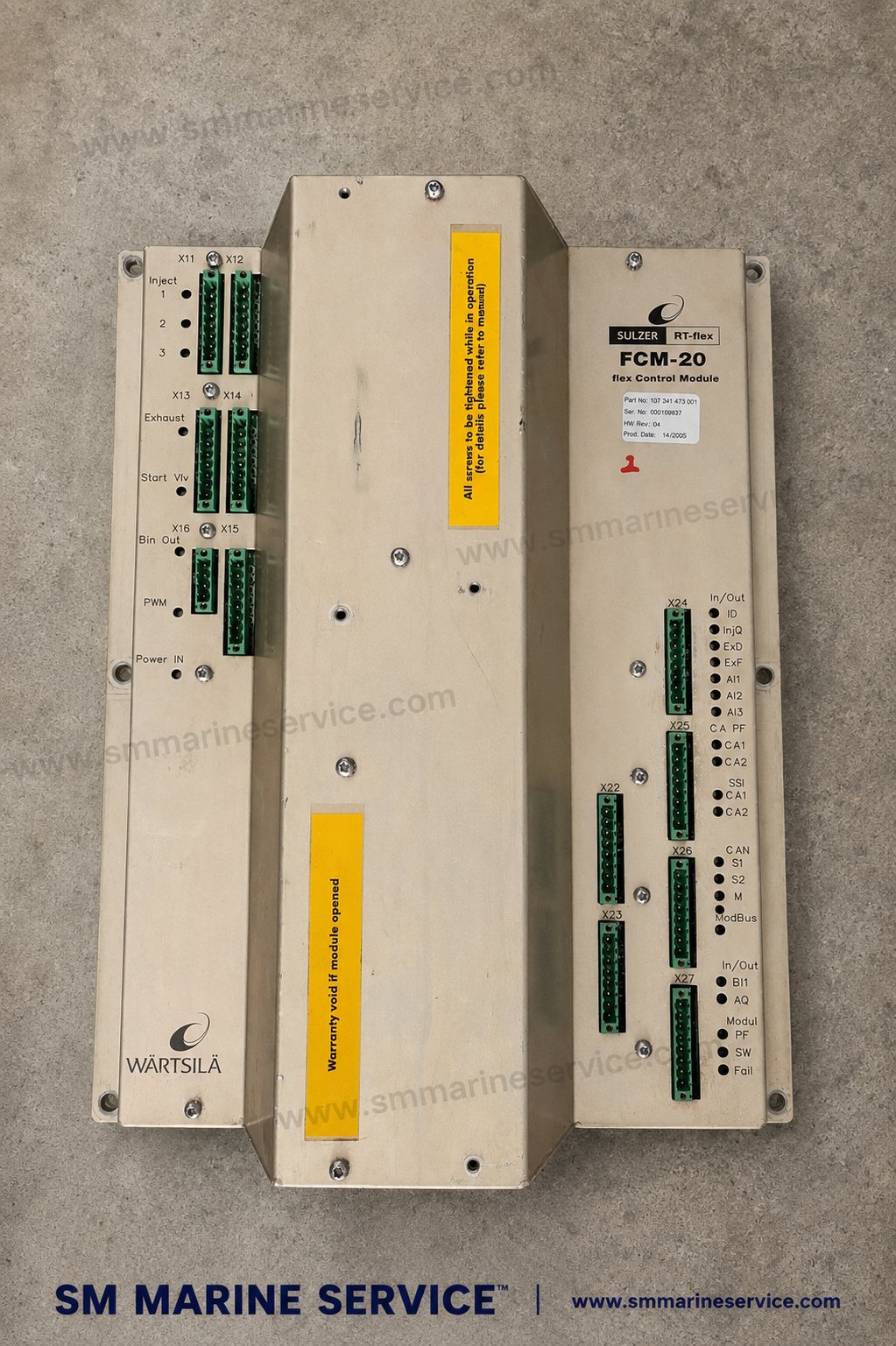
The equipment shown in your image is a Wärtsilä Sulzer RT-flex FCM-20 Flex Control Module, part of the WECS-9520 electronic engine control system used on Sulzer / Wärtsilä RT-flex low-speed two-stroke main engines. The label in the photo clearly identifies it as:
This is not a general automation card. It is a critical engine control module mounted on RT-flex engines to control and monitor key cylinder-related and common engine functions such as fuel injection, exhaust valve actuation, start valve control, rail pressure-related functions, and communication with the WECS engine control network.
The RT-flex engine platform replaced the traditional camshaft-driven fuel injection concept with an electronically controlled common rail system. In this design, the FCM-20 module plays a major role in the real-time control of injection and exhaust timing. Wärtsilä training and RT-flex control documentation describe the WECS-9520 as the core engine control system and note that each cylinder has its own FCM-20 module for cylinder-related and common functions.
For chief engineers, superintendents, and marine engine spare-parts buyers, the FCM-20 is a very important spare because failure of one module can affect fuel injection timing, exhaust valve control, cylinder operation, engine performance, and alarm status on an RT-flex main engine.


The FCM-20 is a microprocessor-based control module used within the WECS-9520 (Wärtsilä Engine Control System) of RT-flex engines. Its job is to execute engine control commands for the RT-flex common rail system and to monitor related feedback signals.
In the RT-flex concept, the engine no longer depends on a conventional camshaft for fuel injection and exhaust actuation. Instead, the engine uses electronic control, hydraulic actuation, and common rail technology. The FCM-20 module is one of the main building blocks that make this possible.
Wärtsilä RT-flex technical references describe the FCM-20 as the control module responsible for functions such as:
RT-flex technical literature and training material state that the WECS system controls fuel injection via the Flex Control Module (FCM-20) and that the module regulates start and end of injection while monitoring injection-related behaviour.
The FCM-20 is one of the key control modules in the RT-flex engine control architecture. WECS-9520 documentation explains that the system processes the actuation, regulation, and control directly linked to the engine, with FCM-20 modules mounted on the engine and communicating over the internal system CAN bus.
The FCM-20 works with the RT-flex common rail system to manage injection timing and injection control logic for efficient combustion.
RT-flex engines use electronically controlled exhaust valve actuation rather than a purely mechanical camshaft system. The FCM-20 handles this control as part of cylinder operation.
From the terminal markings visible on the module, it is clear that the FCM-20 interfaces with Inject, Exhaust, Start Vlv, PWM, and related I/O sections—showing its role in direct engine actuation control.
The RT-flex concept is built around electronic control for better combustion flexibility, low-speed operation, emission performance, and fuel efficiency. The FCM-20 is one of the modules enabling that architecture. RT-flex technical reviews describe the system as a modular electronically controlled common rail engine platform.
The module in your photo shows several field connection points and labels that help identify its function:
These markings confirm that the FCM-20 is not a simple sensor interface—it is a multi-function engine control module with actuation outputs, analogue/digital inputs, and communication interfaces.
In practical terms, the FCM-20 assembly includes:
The FCM-20 Flex Control Module is used in Wärtsilä Sulzer RT-flex electronically controlled low-speed two-stroke main engines. Typical applications include:
Because RT-flex engines are common on large oceangoing vessels, the FCM-20 remains an important spare part in the marine market.
Possible causes: failed FCM-20 output stage, injection control signal fault, wiring issue to injection actuator, communication issue, internal module failure.
Checks: compare affected cylinder with healthy cylinder, inspect module LEDs / diagnostics if available, verify wiring and actuator feedback.
Possible causes: FCM-20 output fault, hydraulic / solenoid interface problem, bad feedback signal, module communication issue.
Checks: inspect exhaust valve command path, actuator response, and compare cylinder channel behaviour.
Possible causes: FCM-20 start valve output issue, faulty start valve wiring, binary output fault, related WECS alarm.
Checks: inspect start valve output circuit and module fault indications.
Possible causes: power supply fault, CAN communication problem, internal processor fault, connector issue, module hardware failure.
Checks: verify Power IN, communication lines, module health, and WECS system alarm logs.
Possible causes: faulty sensor feedback, analogue input issue, module processing fault, engine-side actuator problem.
Checks: inspect AI inputs, feedback wiring, and cylinder-specific alarms in the WECS system.
A failure-code overview for FCM-20 / WECS-9520 systems exists in training and service material, which shows that the module can generate extensive diagnostic fault information for engine troubleshooting.
For RT-flex engines, module replacement should always be done carefully because the FCM-20 is directly linked to main engine combustion and actuation control.
Ships continue to use the FCM-20 because many RT-flex engines remain in active service and still rely on the WECS-9520 electronic control platform. Replacing the entire engine control architecture is not practical, so operators maintain reliability by sourcing correct FCM-20 spares, tested used units, refurbished modules, or repair support.
It is a Flex Control Module used in the WECS-9520 engine control system of Wärtsilä Sulzer RT-flex engines for fuel injection, exhaust valve control, and other cylinder-related functions.
RT-flex WECS-9520 references indicate that each cylinder has its own FCM-20 module for cylinder-related and common functions.
The engine may suffer cylinder control faults, injection problems, exhaust valve control alarms, module communication faults, or degraded engine performance.
The image shows Part No. 107 341 473 001.
Please send:
Marine Automation & Navigation Equipment Supplier
Available Condition:
• New Equipment • Used Equipment • Refurbished Equipment • Reconditioned Equipment
Stock Location:
• Bangladesh • China
Services:
• Worldwide Shipping • Technical Support • Spare Parts Supply • Marine Equipment Sourcing
SM MARINE SERVICE™ Samir Market, DT Road, Pahartali, beside CDA Market, Chattogram, Bangladesh
Mobile / WhatsApp / Viber: +88 01818 929292
Email: info@smmarineservice.com
Website: www.smmarineservice.com
0
BDT 0
BDT 0
BDT 0
BDT 0
Marine Equipment Supplier