Consilium CS3004 Marine Fire Alarm Control Panel | Salwico CS3000 Fire Detection System
Item Code:
FIRE ALARM SYSTEM
Consilium CS3004 Marine Fire Alarm Control Panel | Salwico CS3000 Fire Detection System Operator Unit, PCB, Display & Spare Parts
Title
Consilium CS3004 Marine Fire Alarm Control Panel | Salwico CS3000 Fire Detection System Spare Parts & Repair Support
Description
Consilium CS3004 Marine Fire Alarm Control Panel for Salwico CS3000 Fire Detection Systems
Product Introduction
The Consilium CS3004 is a well-known marine fire alarm control and operator panel used in Consilium / Salwico CS3000 series fire detection systems installed on merchant vessels, offshore vessels, tankers, cargo ships, passenger vessels, and engine-room protected spaces. It is part of a fire detection architecture designed to monitor smoke detectors, heat detectors, manual call points, fault signals, and system alarms from multiple fire zones on board.
In many ships, the CS3004 front operator unit, display module, power board, main control PCB, and associated repeater / interface units remain in service even after many years because the Salwico system is rugged, simple to maintain, and still widely understood by marine electricians and ship engineers. That is why demand remains strong for Consilium CS3004 front panels, Senator M3000 display units, fire alarm control boards, spare PCBs, repair support, and replacement modules.
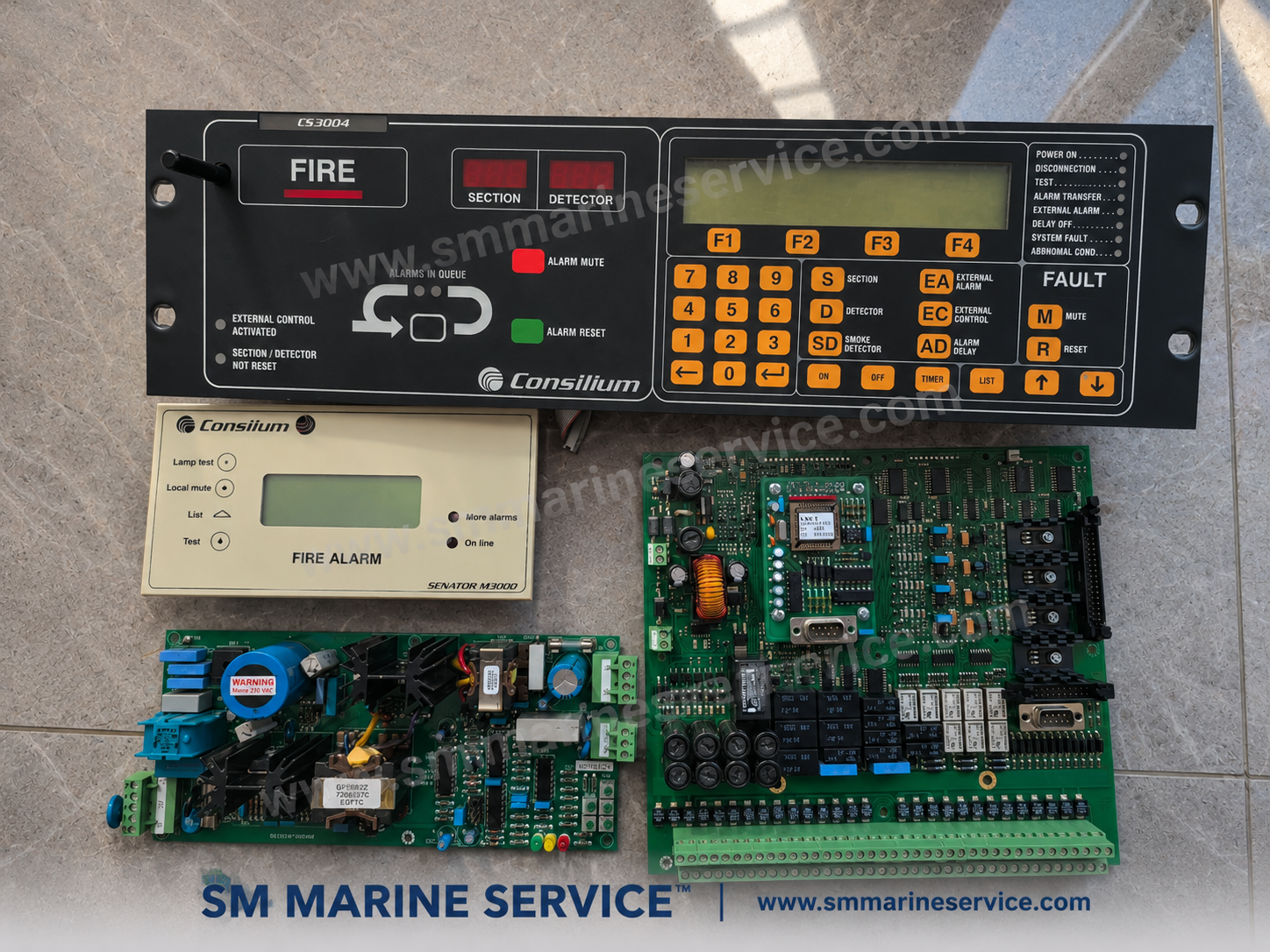
The product image provided shows a typical CS3004 fire alarm front panel assembly together with associated Consilium electronics boards and a Senator M3000 fire alarm display unit—exactly the type of spare parts package marine operators often need when an older vessel’s fire detection system develops display faults, power board failures, detector communication issues, or front-panel button problems.
SM MARINE SERVICE™ supports shipowners, managers, superintendents, and marine engineers with sourcing for Consilium CS3004 operator units, Salwico fire alarm spare parts, marine fire detection boards, used and reconditioned control panels, and troubleshooting support.
Manufacturer
Consilium / Salwico
Country of Origin
Sweden (Consilium / Salwico marine fire and gas safety systems are Swedish-origin products, widely used in marine safety installations)
Product Type
Marine Fire Alarm Control Panel / Operator Unit / Fire Detection System Control Interface
Marine Application
- Shipboard fire detection and alarm systems
- Accommodation fire alarm monitoring
- Engine room fire alarm supervision
- Machinery space fire detection
- Cargo hold / service space fire monitoring
- Alarm repeater and detector loop supervision
- Fire system fault, disconnection, and external alarm handling
What Is the Consilium CS3004?
The Consilium CS3004 is an operator and control interface panel for a marine fire detection system, generally associated with the Salwico CS3000 platform. It allows the crew to:
- monitor active fire alarms
- identify the section / zone / detector in alarm
- mute audible alarms
- reset alarms after verification
- view detector and system fault information
- handle external alarm conditions
- manage detector isolation / disconnection functions
- review alarm queues and system status
It is not just a “display panel.” In practical shipboard use, the CS3004 forms part of the vessel’s central fire alarm operating interface, linking the crew to the system’s detector network, logic boards, power supply circuits, and alarm outputs.
In older installations, the CS3004 may be seen together with:
- Senator M3000 fire alarm display / repeater unit
- main control PCB
- detector loop / interface board
- power supply / charger board
- alarm output modules
- terminal boards and communication harnesses
Main Features of the Consilium CS3004 Fire Alarm System
The exact configuration can vary by vessel and installation, but a typical Consilium CS3004 / Salwico CS3000 setup offers the following functional features:
1) Fire Alarm Indication by Zone / Detector
The CS3004 panel is designed to identify alarm conditions by section and detector, allowing the operator to quickly locate the fire source or activated device.
2) LCD / Operator Display for System Information
The operator display presents system status, alarm conditions, fault messages, detector information, and menu-based navigation for diagnostics or configuration-related access.
3) Dedicated Alarm Handling Buttons
The front panel typically includes buttons for:
- Mute
- Reset
- List / alarm review
- External alarm
- Detector / section selection
- function keys and navigation keys
These are critical during onboard alarm response.
4) Fault Monitoring
The CS3004 monitors not only fire alarms but also multiple fault states such as:
- system fault
- detector communication issue
- external control activated
- alarm delay active
- disconnection / isolate status
- abnormal condition or power issue
5) Integration with Detector Loops and Control Boards
The CS3004 works together with internal system boards that supervise field detectors, call points, alarm sounders, and output relays.
6) Suitable for Marine Environment
Consilium marine fire alarm systems are built specifically for marine service, where vibration, humidity, long service life, and high reliability are expected.
7) Expandable Fire Detection Architecture
In many ships, the CS3004 is one visible part of a larger system that may include:
- repeater panels
- engine room local display units
- loop cards
- alarm interface boards
- bridge or ECR repeater indication
Main Components Seen in a Consilium CS3004 Fire Alarm Package
Based on the product set shown in the image and common Salwico system architecture, a CS3004 fire alarm package may include the following major items:
1) CS3004 Front Operator Panel
This is the black operator fascia / control front that includes:
- LCD window
- keypad and function keys
- fire and fault indication areas
- mute and reset controls
- section / detector access buttons
2) Senator M3000 Fire Alarm Display / Repeater Unit
The smaller beige unit shown in the image appears to be a Senator M3000 display module used for fire alarm indication, testing, local mute, and list handling. These units are often used as repeaters or auxiliary control/display interfaces depending on system design.
3) Main Control PCB
The large green board is typically the main processing / logic board, which may manage:
- system logic
- communication
- detector input handling
- relay outputs
- alarm processing
- interface with the front operator panel
4) Power Supply / Charger Board
The lower green PCB in the image appears consistent with a power / charging / system supply board. In marine fire alarm systems, this board usually handles:
- AC / DC conversion
- battery charging
- power distribution
- fault supervision
- output power monitoring
5) Connectors, Relay Outputs, Interface Terminals
The main board generally includes:
- field wiring terminals
- serial communication connectors
- relay outputs
- detector loop connections
- fuse / protection sections
- onboard status indicators
How the Consilium CS3004 Works in a Ship Fire Detection System
A marine fire detection system must do more than simply sound a buzzer. It continuously supervises the vessel for fire and system integrity. The CS3004 operator panel forms part of that control process.
Normal Monitoring State
During normal operation, the fire alarm control system supervises connected devices such as:
- smoke detectors
- heat detectors
- manual call points
- interface modules
- output circuits
- external alarms / repeaters
The panel indicates Power On and keeps the loops under supervision.
Fire Alarm Condition
If a detector senses smoke or heat—or a manual call point is activated—the system processes the signal and displays the relevant alarm information. Depending on configuration, the operator may see:
- section number
- detector number
- detector type
- alarm queue
- external alarm activation
- delayed alarm conditions
The system also triggers local and remote outputs such as:
- bridge alarm
- engine control room alarm
- general fire alarm interface
- shutdown or monitoring outputs depending on vessel arrangement
Fault Condition
If the system detects a wiring break, power issue, detector communication fault, board fault, or disabled section, the fault indication section activates and the display provides status information for troubleshooting.
Operator Actions
The crew can then:
- mute the buzzer
- review alarm list
- check the affected detector / section
- reset after investigation
- isolate / disable sections if required under controlled maintenance
Typical Marine Applications
The Consilium CS3004 / Salwico fire detection system is used across many shipboard fire protection zones, including:
Accommodation Areas
- cabins
- corridors
- stair towers
- mess rooms
- offices
- stores
Engine Room / Machinery Spaces
- purifier room
- engine control room
- workshop
- switchboard room
- machinery flats
- pump rooms where applicable in protected arrangements
Service & Technical Spaces
- laundry
- provision rooms
- electrical spaces
- air conditioning rooms
- steering gear room depending on system design
Cargo and Special Areas
Depending on vessel type and fire plan, the system may also supervise:
- cargo service spaces
- control stations
- machinery casings
- emergency generator spaces
- selected hold or ancillary spaces
Common Problems in Consilium CS3004 Fire Alarm Systems
Older marine fire alarm systems often remain reliable for years, but they do develop recurring faults. The following are common field issues marine engineers and ETOs may encounter.
1) Front Panel Dead / Blank Display
Symptoms:
- LCD display blank
- no keypad response
- no status indication
- panel appears completely dead
Possible causes:
- failed power supply board
- blown fuse
- DC supply missing
- flat or failed backup battery affecting system stability
- display board / front panel ribbon cable issue
- main control board failure
Checks:
- verify incoming supply to panel
- check charger / PSU board output
- inspect fuse and PCB indicators
- inspect front-panel cable connection
- check for burnt components or capacitor failure
2) System Fault LED / Continuous Fault Alarm
Symptoms:
- FAULT indication remains active
- system buzzer repeatedly sounds
- fault returns after reset
Possible causes:
- detector loop fault
- communication failure between main board and operator panel
- battery / charger fault
- external alarm circuit fault
- defective detector or loop wiring issue
- failed interface relay or onboard power regulator
Checks:
- read exact fault text on display if available
- inspect loop continuity
- isolate suspect section if procedure allows
- measure PSU voltages
- inspect battery health and charging current
- verify detector wiring for short/open circuit
3) Section / Detector Not Resetting
Symptoms:
- section remains in alarm or fault after reset
- “section/detector not reset” indication persists
- one detector keeps re-triggering
Possible causes:
- contaminated smoke detector
- defective detector head
- shorted detector base
- water ingress in field device
- damaged field cable
- detector loop board problem
Checks:
- identify repeated detector number
- inspect the detector physically
- swap suspect detector with a healthy location if allowed by maintenance procedure
- measure line condition
- inspect detector base and terminal corrosion
4) Alarm Mute / Reset Buttons Not Working
Symptoms:
- front panel keys do not respond
- only some keys work
- panel display is active but commands fail
Possible causes:
- membrane keypad or switch failure
- front operator board fault
- communication loss between keypad and main PCB
- software / CPU hang condition
- connector oxidation
Checks:
- inspect front panel ribbon cable
- test local repeater or alternative operator interface if fitted
- power-cycle under approved maintenance procedure only
- inspect key matrix board for damage
5) Repeated Detector Faults in One Zone
Symptoms:
- same section repeatedly shows detector trouble
- intermittent false alarms or disconnections
- faults worsen during humid weather or vibration
Possible causes:
- aged detector
- dirty ion/smoke chamber
- loop resistance issue
- cable insulation deterioration
- loose terminals in junction box
- moisture in detector base or cable glands
Checks:
- inspect field wiring route
- tighten terminals
- clean or replace detector head
- megger only if permitted by OEM and with devices disconnected as required
- compare loop values with healthy sections
6) Power Board Failure / Charging Problem
Symptoms:
- panel unstable
- battery alarm
- system restarts
- loss of display brightness or repeated boot behavior
- fire panel fails during mains interruption
Possible causes:
- failed charger board
- bad electrolytic capacitors
- defective transformer / regulator stage
- exhausted batteries
- poor terminal connections
Checks:
- measure battery voltage
- verify charger float voltage
- inspect rectifier / charging section
- check for overheated components on PSU board
Practical Troubleshooting Approach for Marine Engineers
When troubleshooting a Consilium CS3004 / Salwico fire alarm system, a disciplined approach is important because the system is safety-critical.
Step 1 – Identify the Exact Alarm or Fault
Use the display and front panel indicators to determine whether the issue is:
- Fire alarm
- Detector fault
- Section fault
- External alarm issue
- System fault
- Power failure
- Battery / charger fault
- Communication issue
Step 2 – Determine Whether It Is Field Side or Panel Side
Ask:
- Is the fault linked to one detector / section only?
- Are multiple zones affected?
- Is the display panel itself unstable?
- Is the power supply normal?
This helps separate field detector problems from panel electronics problems.
Step 3 – Inspect the Power Supply First
Many mysterious fire alarm faults are actually caused by:
- unstable DC supply
- poor battery condition
- charger failure
- loose earth / negative return
Step 4 – Check Field Wiring and Detector Condition
If the problem is limited to one zone or one detector, inspect:
- detector head
- base
- cable joints
- loop continuity
- moisture / corrosion
Step 5 – Inspect Main PCB and Front Panel Connections
For display, keypad, or logic faults:
- inspect ribbon connectors
- reseat plug-in connectors where appropriate
- check for damaged relay sockets, burned resistors, or swollen capacitors
- inspect for dry solder joints on older boards
Step 6 – Replace Suspect Module with Verified Spare
If a main board, power board, or operator panel is faulty and the vessel carries spares, controlled replacement is often the fastest restoration method.
Maintenance Tips for Consilium CS3004 Fire Alarm Systems
To keep a CS3004-based fire detection system healthy, the following maintenance practices are recommended:
Routine Maintenance
- Test fire alarm indications according to vessel PMS and class requirements
- Inspect front panel display, keys, LEDs, and audible alarm operation
- Verify power supply and battery charger status
- Clean detector heads according to approved procedure
- Check repeater and remote alarm functions
- Inspect detector loops and terminals for looseness or corrosion
- Confirm proper section and detector labeling for crew response
Preventive Electrical Checks
- measure charger voltage and battery condition
- inspect power board for overheating
- check PCB terminal tightness
- inspect cable glands for moisture ingress
- verify system earth and shielding condition where applicable
Spare Parts Worth Keeping
For older vessels still using Consilium / Salwico CS3000 systems, it is practical to keep:
- CS3004 front operator panel or display unit
- Senator M3000 display / repeater unit
- power supply / charger board
- main control PCB
- selected detector heads / bases
- fuses, relays, and connector accessories
SM MARINE SERVICE™ can support this type of spare-parts planning for vessels that still rely on legacy marine fire alarm systems.
Why Ships Still Use the Consilium CS3004
Even though newer fire alarm systems are available, many ships still retain the Consilium CS3004 / Salwico CS3000 platform because:
- it is proven in marine service
- ship crews and ETOs are familiar with it
- spare board-level repair is still possible in many cases
- detector logic is straightforward for onboard fault-finding
- replacing the entire system is much more expensive than maintaining the existing one
- class-compliant fire detection performance can still be maintained with proper upkeep
For older vessels, the biggest challenge is usually not the system design itself—it is the availability of front panels, power boards, main control boards, and repeater units. That is where specialized marine suppliers remain important.
Frequently Asked Questions (FAQ)
What is the Consilium CS3004?
The Consilium CS3004 is a marine fire alarm control / operator panel used with Salwico CS3000 fire detection systems for alarm indication, fault handling, detector identification, muting, and reset operations.
Is CS3004 a complete fire alarm system by itself?
No. The CS3004 is usually one key part of a larger fire detection system that includes:
- detectors
- control boards
- power supply / charger board
- repeaters
- output circuits
- communication / loop interfaces
What is the Senator M3000 shown with the system?
The Senator M3000 is typically a fire alarm display / repeater or auxiliary control unit used in conjunction with the Consilium fire alarm system, depending on vessel configuration.
What are common CS3004 faults?
Common problems include:
- blank display
- system fault indication
- power board failure
- detector loop fault
- repeated false alarm from one detector
- front keypad failure
- battery charger problems
Can the main PCB and power board be replaced separately?
Yes, on many older marine systems the boards are separate modules and can be replaced or repaired individually, provided the correct part is sourced and installation is done by qualified personnel.
Do you supply used or reconditioned Consilium CS3004 spare parts?
SM MARINE SERVICE™ supports inquiries for used, refurbished, reconditioned, and replacement spare parts for marine fire alarm systems, including Consilium / Salwico models subject to stock availability.
Short Product Description
The Consilium CS3004 is a marine fire alarm control and operator panel used in Salwico CS3000 fire detection systems on ships and offshore vessels. It provides alarm display, detector and section indication, fault monitoring, mute and reset functions, and operator access to fire alarm system status. The system is widely used in marine accommodation spaces, machinery spaces, and protected shipboard areas, and remains a common requirement for spare parts, repair, and replacement PCB support.
User Manual & Technical Resources
Below are useful technical references and product resources related to the Consilium CS3004 / Salwico marine fire alarm system. For onboard maintenance, always cross-check with the vessel’s installed system drawings, detector list, and fire alarm loop documentation.
SM MARINE SERVICE™
Marine Automation & Navigation Equipment Supplier
Available Condition:
• New Equipment • Used Equipment • Refurbished Equipment • Reconditioned Equipment
Stock Location:
• Bangladesh • China
Services:
• Worldwide Shipping • Technical Support • Spare Parts Supply • Marine Equipment Sourcing
Contact Information
SM MARINE SERVICE™ Samir Market, DT Road, Pahartali, beside CDA Market, Chattogram, Bangladesh
Mobile / WhatsApp / Viber: +88 01818 929292
Email: info@smmarineservice.com
Website: www.smmarineservice.com