I/O Modules
Baker Hughes - Bently Nevada
Refurbished
Bently Nevada 3500 Marine Machinery Protection System | Vibration Monitoring, Transient Data Interface, Relay Module, I/O Modules Supply & Service by SM MARINE SERVICE™
The Bently Nevada 3500 is a highly respected machinery protection and condition monitoring system widely used in marine, offshore, industrial, and power-generation environments. Onboard ships, this system is commonly installed to monitor the health of main engine auxiliaries, turbochargers, pumps, compressors, fans, blowers, shaft-related machinery, and other rotating equipment where continuous vibration and condition monitoring are essential.
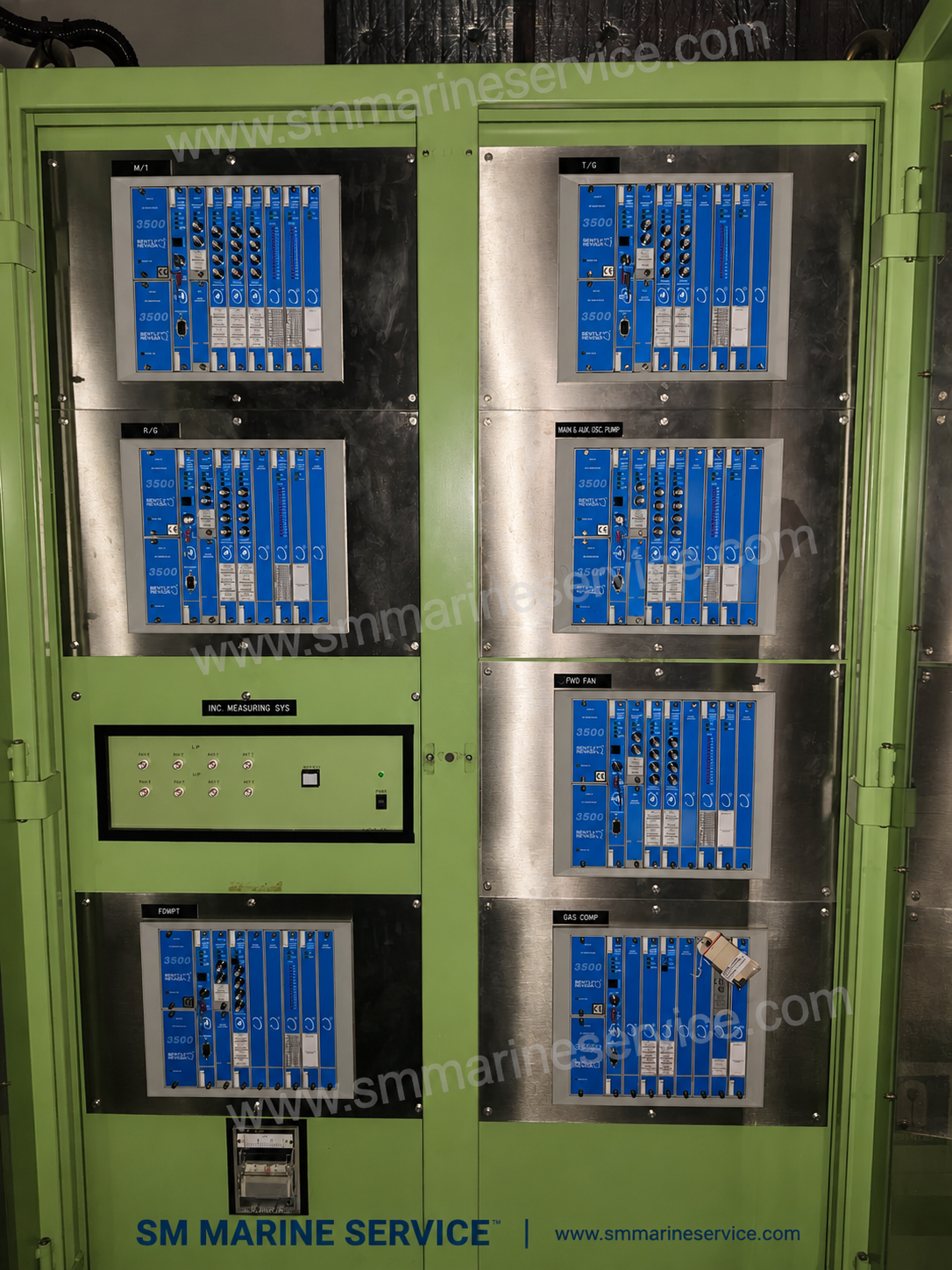
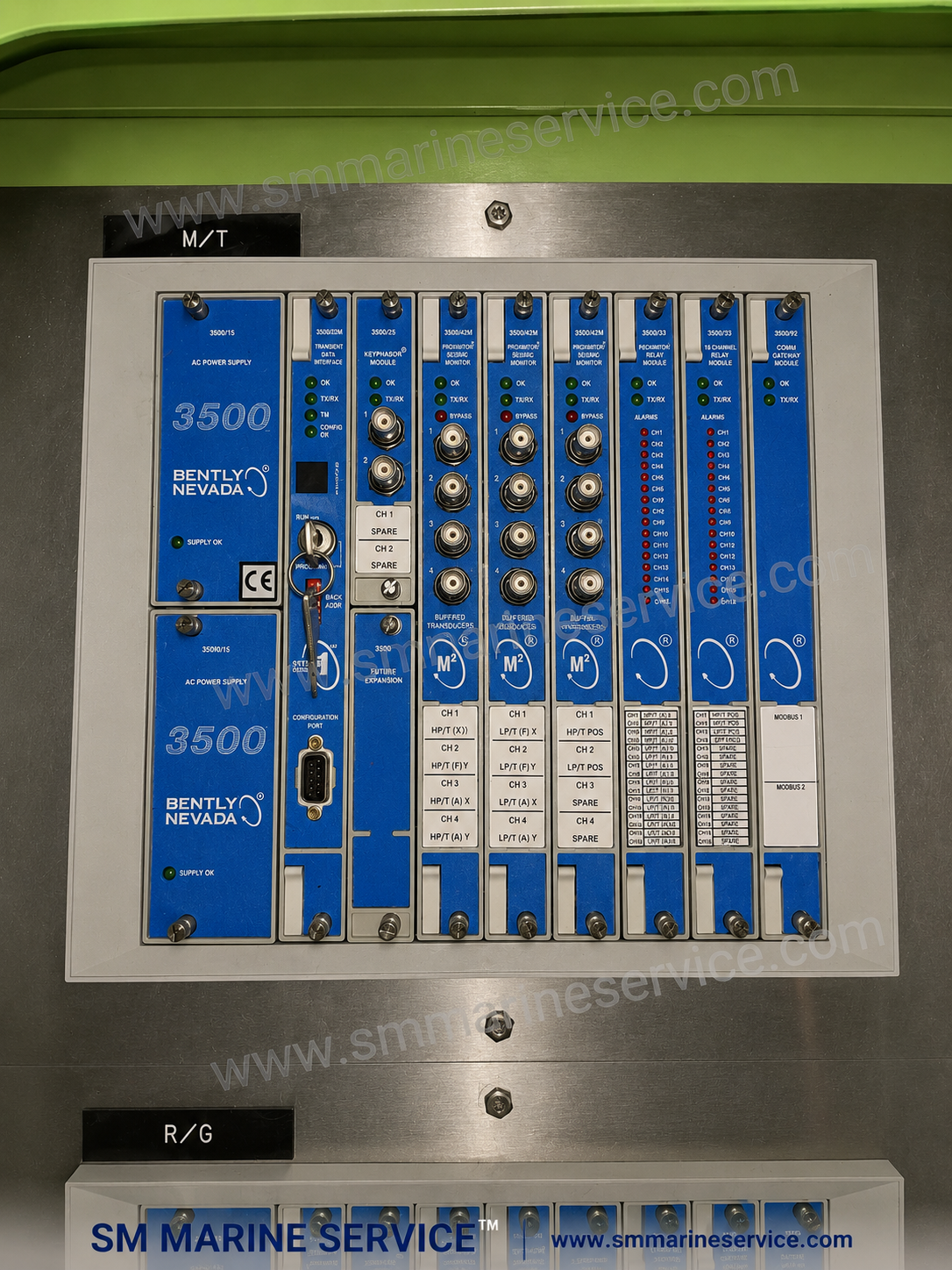
From the images you provided, the system shown is a multi-rack Bently Nevada 3500 installation, with separate monitoring sections for different machinery groups. The rack clearly includes important modules such as:
This type of arrangement is very common in engine room integrated machinery monitoring systems, especially when several critical pumps, fans, compressors, and rotating machines must be monitored from one centralized protection platform.
SM MARINE SERVICE™ supports shipowners, managers, marine engineers, repair teams, and buyers with Bently Nevada 3500 system supply, module sourcing, repair support, troubleshooting assistance, and spare parts support for marine use.
The Bently Nevada 3500 is a rack-based machinery protection system designed to continuously monitor the condition of rotating equipment and provide alarm, trip, relay, event, and communication outputs when machinery parameters move outside safe limits.
In simple terms, it acts as the electronic protection and monitoring brain for important rotating machinery. It gathers signals from vibration probes, displacement probes, speed sensors, thrust sensors, and other condition-monitoring inputs, then converts those signals into:
On ships, this is especially valuable because rotating equipment often runs continuously for long periods under varying load, temperature, and sea conditions. A system like the 3500 helps engineers identify abnormal vibration or machine instability before it turns into a major failure.
From your uploaded images, this is not a single standalone module; it is a full marine monitoring cabinet arrangement with multiple Bently Nevada 3500 racks assigned to different machinery groups.
The cabinet labels visible in the photos indicate dedicated monitoring sections for several machine groups, including examples such as:
This tells us the system is configured as a distributed machinery monitoring network inside one marine control cabinet, where each rack or group of modules is used to protect a specific machine or machinery train.
That is one of the major strengths of the Bently Nevada 3500 platform: it can be expanded and customized depending on how many machines need to be monitored and what parameters each machine requires.
A marine Bently Nevada 3500 system is typically used for the following purposes:
The system continuously checks vibration levels on bearings, casing points, shaft locations, or machine housings. If vibration increases beyond normal range, the system generates alarms or trip outputs.
With suitable probe and monitor combinations, the 3500 can monitor shaft displacement, eccentricity, and shaft movement relative to bearings or machine casing.
Using the Keyphasor module, the system can receive once-per-revolution or phase reference signals from the machine shaft. This is important for advanced vibration analysis and phase-related diagnostics.
When dangerous vibration or other critical values are reached, the rack can activate relay outputs to alarm the control room or initiate protective shutdown logic depending on the vessel’s system design.
Through the Transient Data Interface and communication modules, the system can store and transfer machine health data for deeper analysis, trend review, and troubleshooting.
The communication gateway module allows the rack to exchange information with other shipboard monitoring systems, DCS, PLC, or workstation software depending on system configuration.
Below is a practical breakdown of the key modules visible in your image set.
The 3500/15 is the rack’s power supply module. It provides the operating power required by the rack and its installed monitoring modules.
If the power supply becomes unstable or fails, the rack may lose monitoring capability, communication, or alarm functions. That is why a healthy power supply is critical for the entire machinery protection system.
In your image, the 3500/15 AC Power Supply modules are clearly visible on the left side of the rack.
The 3500/22M TDI is one of the most important modules in the rack. It acts as the main interface between the rack and external software / operator systems.
Without a healthy TDI module, engineers may lose:
On a ship, when vibration alarms occur on a pump, fan, or compressor, the TDI helps engineers and service teams review data and understand what happened, when it happened, and which channel was affected.
The 3500/25 Keyphasor module is used to process speed or phase reference signals from the machine.
For rotating machinery diagnostics, simply knowing vibration amplitude is not always enough. Engineers often need to know how that vibration relates to shaft speed and shaft position. The Keyphasor module helps make that possible.
The 3500/42M is a versatile monitoring module used for inputs from proximity probes, seismic transducers, and other dynamic sensors depending on configuration.
The 42M is popular because it can be configured for different monitoring needs depending on the machinery type and sensor arrangement. This makes it very useful in marine applications where one vessel may have several different types of critical equipment.
The 3500/40M is generally associated with proximity probe-based monitoring and is often used where shaft-related measurements are needed.
Machines with sleeve bearings, high-speed shafts, or critical rotor assemblies often require accurate shaft-related monitoring, and the 40M plays an important role in that protection strategy.
The 3500/32 relay module provides physical relay outputs from the rack for alarm or shutdown logic.
Monitoring alone is not enough. If a machine reaches a dangerous condition, the ship may need:
The relay module is what makes that protection action possible.
The 3500/92 Communication Gateway Module is used to share rack information with external systems.
Modern vessels often have multiple layers of automation, alarm handling, and monitoring. The communication gateway helps the Bently Nevada rack become part of that larger shipboard information system rather than operating as an isolated panel.
Even today, the Bently Nevada 3500 remains highly valuable because marine engineers need a system that is:
Many vessels continue to operate with legacy or mid-generation monitoring systems for years. As long as the machinery remains in service, owners still need module replacement, rack repair, system inspection, configuration assistance, and spare unit sourcing.
This is exactly why Bently Nevada 3500 spare parts and service support remain in demand in the marine sector.
SM MARINE SERVICE™ supports this kind of ongoing marine requirement with practical supply and technical assistance for legacy and active machinery monitoring systems.
A Bently Nevada 3500 installation may be used to protect and monitor machinery such as:
From the labels visible in your cabinet image, the system appears to be dedicated to multiple pumps, fans, compressor sections, and machinery groups rather than just one single machine.
Although the 3500 is reliable, ships and offshore units can still face operational issues due to age, environment, wiring faults, or module problems. Common issues include:
In many cases, the problem is not the machine itself but a related issue such as:
The Bently Nevada 3500 is not just a display rack or alarm unit. It is a complete machinery protection and condition monitoring platform that receives signals from sensors installed on rotating equipment, processes those signals through dedicated monitor modules, compares them with configured alarm and danger limits, and then sends the result to alarm, relay, and communication systems.
In a marine installation, the working sequence is generally as follows:
Sensors are mounted on the machinery that needs protection. Depending on the machine design, these may include:
These sensors are fitted on machines such as:
The field signals are wired into the relevant monitor modules inside the rack, such as:
Each module is responsible for a specific type of signal or monitoring function.
The installed monitor module checks:
If a value exceeds the configured limits, the system can generate:
If the system is configured for protective action, the 3500/32 Relay Module can energize or de-energize relay contacts for:
The 3500/22M TDI and 3500/92 Communication Gateway allow engineers or integrated monitoring systems to read:
This is why the 3500 is both a protection system and a diagnostic monitoring system.
A Bently Nevada 3500 rack works as a coordinated system. Each module has a defined role, but the rack only becomes useful when all of them work together correctly.
Provides rack operating power. Without stable power, no module can function correctly.
Acts as the communication and system interface core. It is the main access point for rack data, configuration, and diagnostics.
Supplies speed / phase reference information from rotating machinery. Important for advanced vibration interpretation.
Receive the actual machine signals from probes and sensors, then convert those signals into engineering values and alarm logic.
Takes alarm / danger decisions from the monitoring logic and converts them into output contacts for real plant action.
Passes information to external monitoring systems, control systems, or supervisory networks.
In a real engine room, this means the rack is constantly doing three jobs at once:
Your uploaded photos show a large multi-rack machinery protection cabinet rather than a small local installation. This is a serious marine machinery monitoring arrangement designed to supervise multiple equipment groups.
The visible labels suggest dedicated rack sections for different machines or systems. While the exact ship application should always be confirmed from vessel drawings and configuration files, the cabinet strongly indicates a setup similar to the following.
The label Gas Comp strongly suggests that one rack is used for gas compressor monitoring. Compressors are one of the most vibration-sensitive machines on board, especially if they operate at high speed or under variable load.
The Bently Nevada 3500 may monitor:
This protects the compressor from developing severe vibration, rotor instability, or bearing-related failure.
The label Main & Aux. DSC. Pump indicates a dedicated monitoring section for pump machinery. Pumps are critical in marine systems and often run continuously, which makes vibration protection highly valuable.
Typical pump-related monitoring includes:
The label FWD Fan suggests a fan or blower monitoring section. Fans and blowers can suffer from:
The Bently Nevada rack helps detect these conditions before the machine reaches a destructive stage.
The other labels such as M/T, R/G, M/1, T/G, B/G suggest that the cabinet is divided into several machinery trains or machinery groups. Depending on vessel design, these could correspond to:
This is exactly the kind of application for which the 3500 platform is ideal: one cabinet, multiple racks, multiple critical machines, centralized monitoring and protection.
A simple vibration switch only tells you that a vibration threshold has been crossed. The Bently Nevada 3500 does far more than that.
That is why it is commonly selected for high-value rotating machinery where basic trip switches are not enough.
Below is a practical marine-oriented troubleshooting guide based on common field situations.
When a Bently Nevada 3500 problem appears, do not immediately assume the module is defective. Troubleshooting should normally be divided into four zones:
This four-zone approach prevents unnecessary module replacement and saves time during onboard troubleshooting.
A good marine maintenance routine for the 3500 should include the following:
For ships that rely heavily on this system, it is wise to maintain or source access to spare modules such as:
Many marine vessels still operate with Bently Nevada 3500 systems because replacing the full monitoring architecture is expensive and often unnecessary if the installed system is still reliable.
That is why shipowners, managers, and service companies often prefer to:
Common marine demand includes:
SM MARINE SERVICE™ can support these requirements by assisting with supply, sourcing, spare modules, technical support, and marine machinery monitoring spare parts procurement.
The Bently Nevada 3500 continues to be used because it offers a strong combination of:
For marine operators, this means they can continue protecting critical machinery without having to completely redesign the engine room monitoring concept.
It is used for machinery protection and condition monitoring of rotating equipment such as pumps, compressors, fans, blowers, turbine-driven units, and other critical machinery.
Yes. That is one of its main jobs. It can monitor shaft vibration, relative vibration, casing vibration, position-related signals, and other machinery condition parameters depending on the installed modules and sensors.
The 3500/22M Transient Data Interface acts as the main rack interface for communication, configuration, event data, and machine monitoring data access.
It receives speed / phase reference signals from the rotating machine, which helps the system perform phase-related diagnostics and advanced vibration analysis.
The rack may still detect alarms, but the external alarm or shutdown outputs may not function correctly if the relay path depends on that module.
Yes, in many cases individual modules such as the power supply, TDI, relay module, communication gateway, or monitor cards can be replaced, subject to correct procedure, compatibility, and system configuration requirements.
No. It can also be caused by probe issues, cable faults, loose connectors, configuration problems, module faults, or signal noise. Proper troubleshooting is required before concluding that the machine itself is faulty.
The Bently Nevada 3500 is a modular machinery protection and condition monitoring system used to supervise critical rotating equipment on ships and offshore units. It combines power supply, monitoring, speed reference, relay, communication, and diagnostic interface functions in one rack-based platform. In marine service, it is commonly used for compressors, pumps, fans, blowers, and other vibration-sensitive machinery, helping engineers detect abnormal conditions early and protect valuable equipment from severe damage.
If your vessel, offshore unit, or marine workshop requires Bently Nevada 3500 modules, rack spare parts, replacement cards, troubleshooting assistance, or sourcing support, SM MARINE SERVICE™ can support your requirement.
We support marine and offshore customers for a wide range of machinery monitoring and automation spare parts, including new equipment and reconditioned equipment depending on customer requirements and budget.
Global Marine Equipment & Spare Parts Partner
Bangladesh Office:
Samir Market, DT Road, Pahartali, Beside CDA Market, Chattogram, Bangladesh
China Warehouse & Support Center:
Shanghai, China
Website:
www.smmarineservice.com
Email:
info@smmarineservice.com
WhatsApp / Contact:
+8801818929292
Marketing Contact:
Nazmul Hasan Bhuiyan
0
BDT 0
BDT 0
BDT 0
BDT 0
Marine Equipment Supplier