
Temperature Controller 0–150°C
Nakakita Seisakusho Co., Ltd.
Refurbished
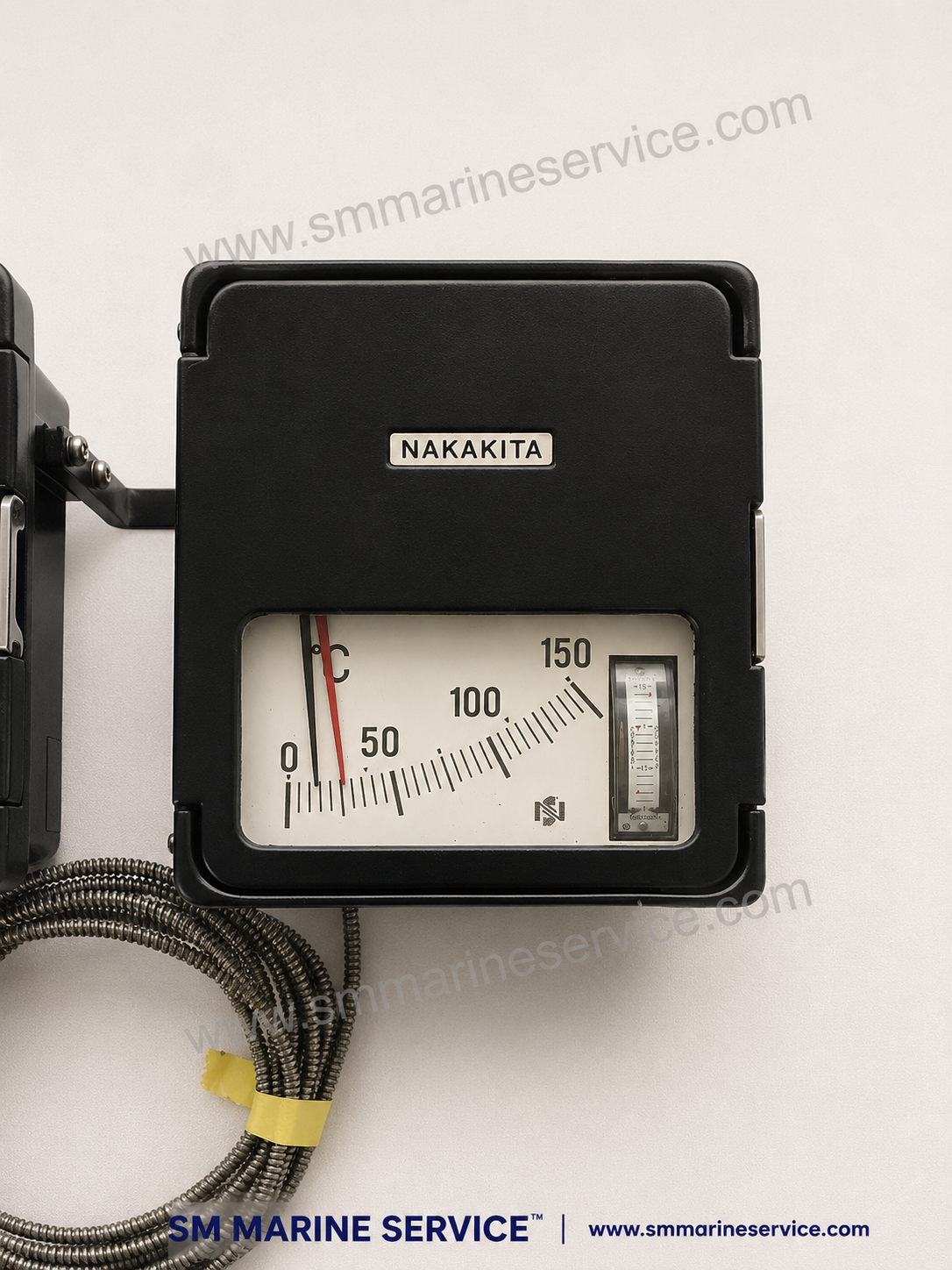
The NAKAKITA Marine Temperature Controller is a traditional marine temperature monitoring and control instrument designed for continuous temperature indication and mechanical control in shipboard systems. From the product photos, this unit appears to be a capillary-type local temperature controller/indicator with a 0–150°C scale, commonly installed in machinery spaces, engine systems, heating lines, and tank service applications where dependable temperature observation is required.
Unlike modern digital transmitters, this type of NAKAKITA instrument is valued for its simple construction, local readability, durable mechanical operation, and long service life in harsh marine environments. On many vessels, these controllers remain in use because they can provide direct local temperature indication without depending heavily on advanced electronics.
SM MARINE SERVICE™ supports the supply, inspection, repair assistance, spare parts sourcing, and replacement support for marine temperature controllers and associated automation components used on ships worldwide.
The NAKAKITA temperature controller is generally used as a local temperature indication and control device for monitoring the temperature of a process medium such as:
This type of controller normally works through a remote sensing bulb connected by a capillary tube to the indicator/controller body. As the sensed temperature changes, the mechanical movement inside the controller reacts and moves the pointer across the dial scale. Depending on the model and internal arrangement, it may also operate a switching or regulating mechanism for temperature control functions.
In practical marine service, this means the unit can be used not only to show temperature locally, but in some installations also to help maintain the desired operating temperature of a heated or circulating system.
Based on the photos provided, this unit can be described as:
Because Nakakita has manufactured several marine automation and instrumentation products over the years, exact model confirmation should ideally be checked from the nameplate, tag number, serial plate, or internal specification label. However, for marine spare parts identification and SEO product listing, the safest commercial naming format is:
or
The NAKAKITA temperature controller is appreciated in marine applications because of several practical design features:
The large front dial gives engineers and technicians a quick local reading of process temperature. This is especially useful in engine rooms or control areas where operators need immediate visual confirmation without opening a digital interface.
The system uses a temperature sensing bulb and capillary tube assembly. This design is widely used in marine applications because it is robust, direct, and suitable for remote temperature measurement from tanks, pipelines, heaters, and machinery systems.
Since this type of unit is fundamentally mechanical in operation, it can provide local indication without the complexity of a modern PLC-based monitoring loop. This makes it valuable for older vessels, retrofit applications, and machinery spaces where straightforward instrumentation is preferred.
From the photos, the controller is housed in a protective enclosure suitable for shipboard use. Marine instruments must tolerate vibration, temperature variation, humidity, and long operating periods, and Nakakita equipment is well known for service in such environments.
Depending on the exact internal mechanism and installation arrangement, the controller may be used for:
One of the major advantages of classic marine mechanical instruments is that many parts can still be inspected, adjusted, repaired, or replaced, such as:
SM MARINE SERVICE™ can support marine buyers looking for replacement units, surplus stock, reconditioned options, or related spare parts for this class of temperature controller.
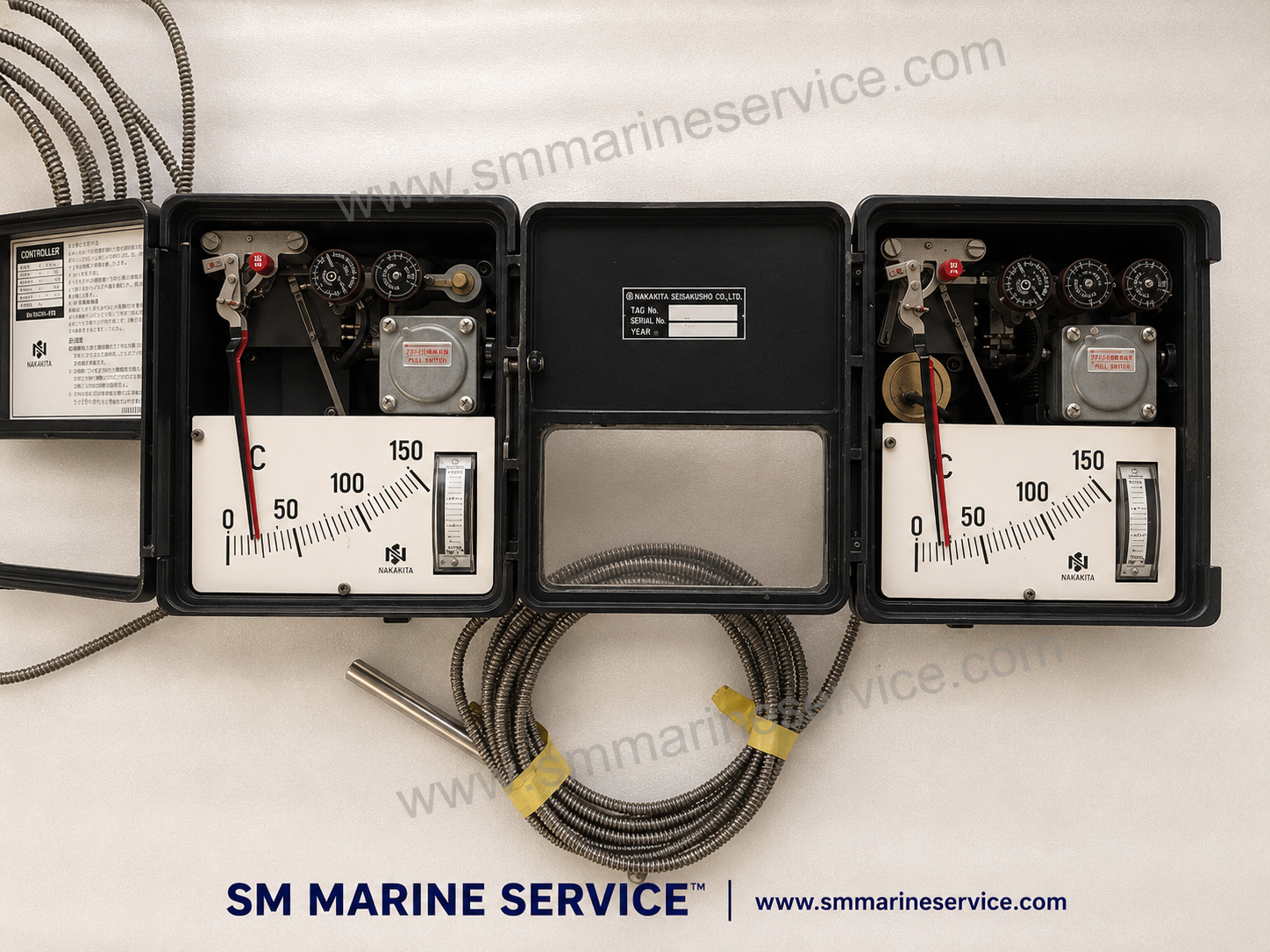
From the photos, the instrument appears to include the following key sections:
The front dial shows the temperature scale up to 150°C, allowing local reading of the monitored process temperature.
The red pointer moves across the calibrated temperature scale according to the thermal response of the sensing system.
The opened-unit image shows the internal adjustment and transmission mechanism, which likely converts the sensing bulb temperature change into pointer movement and possible control action.
The metallic flexible capillary line connects the controller body to the remote sensing bulb. This allows the temperature to be measured at a different physical location from the panel-mounted instrument.
The metal bulb at the end of the capillary assembly is installed into a thermowell, pipe pocket, tank fitting, or other temperature measuring point.
The housing protects the instrument mechanism from accidental damage, dirt, and routine marine operating conditions.
The NAKAKITA Marine Temperature Controller 0–150°C operates on a capillary-type mechanical temperature sensing principle. A remote sensing bulb is installed at the actual temperature measuring point, such as a fuel oil line, lube oil line, heater outlet, or tank heating circuit. This sensing bulb is connected to the controller body through a capillary tube.
When the process temperature rises or falls, the fluid or pressure element inside the sensing system reacts to that temperature change. This mechanical change is transmitted through the capillary system to the controller movement inside the NAKAKITA unit. The result is:
In marine service, this is a very practical design because it allows local temperature reading and basic control without requiring a complex electronic transmitter, PLC signal loop, or digital display unit. For many shipboard systems, especially older Japanese vessels and conventionally instrumented engine rooms, this type of controller remains highly useful.
A NAKAKITA temperature controller of this type can be used in many shipboard temperature monitoring and control applications. Exact installation depends on vessel design and system arrangement, but the most common applications include the following.
Heavy fuel oil systems often require controlled heating to maintain proper viscosity before purification, transfer, or engine use. A capillary temperature controller may be installed to monitor or regulate:
Lubricating oil systems depend on stable temperature for correct viscosity and lubrication performance. These controllers may be used for:
On some vessels, local temperature controllers or indicators are used for engine auxiliary cooling circuits, purifier heaters, or machinery thermal service points where local reading is preferred.
Tank heating systems for fuel, sludge, waste oil, or process liquids may require continuous local temperature indication and sometimes simple temperature control. The NAKAKITA controller can be installed for:
Any marine system that relies on controlled heating can potentially use this type of capillary temperature controller, including:
In some engine rooms, these units are installed simply because they provide reliable local analog indication where operators can quickly confirm whether a system is running within a normal temperature band.
SM MARINE SERVICE™ can support shipowners, managers, chief engineers, marine workshops, and ship chandlers looking for this type of marine temperature controller, related spare parts, or a replacement solution for older shipboard instrumentation.
Even though many modern ships now use digital sensors, transmitters, PLC-based automation, and integrated alarm monitoring systems, mechanical capillary temperature controllers like the NAKAKITA unit are still found on many vessels. There are several reasons for this.
The operating principle is straightforward. A sensing bulb, capillary line, and internal movement provide direct temperature indication and control. This simplicity often means fewer electronic failure points.
A large number of vessels in service today still use traditional Japanese, Korean, and European mechanical instrumentation. Replacing one old mechanical controller with another similar unit is often easier than redesigning the entire control loop.
An engineer can walk up to the unit and immediately see the temperature on the dial. There is no need to enter a software menu, energize a display interface, or interpret a control panel page.
Mechanical controllers of this kind were designed for continuous use in shipboard machinery spaces. When properly maintained, they can remain operational for many years.
Where a system does not require advanced automation, a dedicated local temperature controller may be fully sufficient for the duty.
Like all marine instruments, NAKAKITA temperature controllers can develop faults after long service, vibration exposure, corrosion, mishandling, or aging of internal parts. The following are common problems seen in this class of instrument.
The pointer may show a temperature that is too high, too low, unstable, or inconsistent with the actual system temperature.
Possible causes:
The dial does not move even when the process temperature changes.
Possible causes:
The pointer moves very slowly or does not follow process changes properly.
Possible causes:
If the unit is used for control action rather than indication only, the internal switching/regulating part may fail to operate at the correct setpoint.
Possible causes:
Capillary tubes are one of the most vulnerable parts. If bent too sharply, crushed, cut, or overheated, the entire sensing function can fail.
External damage may not only affect visibility but can also allow moisture and contamination to enter the mechanism.
When a NAKAKITA temperature controller is suspected to be faulty, troubleshooting should be done carefully because the sensing bulb and capillary system are delicate. The following step-by-step checks are useful.
Before condemning the controller, compare the indicated temperature with a trusted reference:
If the actual process temperature is normal but the NAKAKITA reading is incorrect, the fault is likely inside the instrument or sensing assembly.
Check for:
Observe whether the pointer moves smoothly when the measured temperature changes. A stuck or erratic pointer often suggests an internal movement problem.
If safe and permitted by shipboard maintenance procedure, open the enclosure and inspect:
If the controller is used for control action, confirm that the setpoint mechanism has not been disturbed or incorrectly adjusted.
A proper workshop test may be required to confirm:
SM MARINE SERVICE™ can support marine operators and workshops looking for NAKAKITA troubleshooting support, replacement sourcing, or spare parts assistance for shipboard temperature controllers and marine automation devices.
Routine maintenance can significantly improve the service life of a NAKAKITA marine temperature controller. The following practices are recommended.
Remove dust, oil residue, and heavy contamination from the enclosure so the scale remains readable and the housing stays in good condition.
Never kink, fold, twist, or crush the capillary line. During removal or installation, it should be handled very carefully because damage to the capillary usually means loss of sensing function.
The sensing bulb should be properly seated in its thermowell or mounting point so that it receives an accurate process temperature.
Loose mounting can create vibration-related problems and may damage the internal mechanism over time.
If the instrument is important for operational control, compare its reading periodically with a known reference temperature to confirm that it remains within acceptable accuracy.
Where possible, inspect internal mechanical parts for wear, looseness, corrosion, or contamination during scheduled maintenance.
If the sensing bulb, capillary, dial movement, enclosure, or control mechanism is damaged beyond practical repair, replacement is usually the best option.
When shipowners or technical purchasers search for NAKAKITA products, they often need more than the complete controller. In many cases, the urgent requirement is a specific spare part, a replacement sensor assembly, or help identifying the correct unit from an old shipboard installation.
Depending on availability and exact model confirmation, the following items may be relevant when sourcing support for a NAKAKITA marine temperature controller:
SM MARINE SERVICE™ works with marine buyers who are looking for new equipment, replacement units, surplus marine automation stock, reconditioned equipment, or difficult-to-source ship spare parts for older instrumentation systems.
In the marine spare parts market, this type of instrument may be searched under different names depending on the ship, maker’s list, drawing description, or onboard terminology. Common search descriptions include:
For this reason, it is useful to keep the blog and product listing optimized around both controller and indicator related keywords, because buyers may search using either term.
Before ordering a replacement or requesting a quotation, it is best to collect as much of the following information as possible:
If the exact part number is no longer visible, clear photos of the front scale, inside mechanism, tag plate, and sensing bulb assembly can still be very helpful for identification.
It is used for local temperature indication and, depending on the model, basic temperature control in shipboard systems such as fuel oil, lube oil, tank heating, heater lines, and auxiliary machinery temperature points.
No. The unit shown here is a mechanical capillary-type analog temperature controller / indicator rather than a modern digital electronic controller.
From the photos, the visible scale appears to be approximately 0–150°C.
In many cases, mechanical inspection, calibration, internal cleaning, replacement of worn parts, or complete replacement of the sensing assembly may be possible depending on condition and spare availability.
Common failure points include the capillary tube, sensing bulb, internal movement, control linkage, calibration drift, and enclosure damage.
Yes. If you provide clear photos of the unit, front scale, nameplate, internal mechanism, and sensor assembly, SM MARINE SERVICE™ can assist with identification and quotation support based on available information.
The NAKAKITA Marine Temperature Controller 0–150°C is a capillary-type analog temperature indication and control instrument used on ships for local monitoring of fuel oil, lube oil, heating systems, tank temperature, and auxiliary machinery temperature points. Designed for dependable marine service, it combines a remote sensing bulb, capillary transmission system, front dial indication, and internal control mechanism in one compact shipboard instrument. It remains a practical solution for vessels that still operate traditional local mechanical instrumentation systems.
If you are looking for NAKAKITA marine temperature controllers, analog temperature indicators, capillary sensing assemblies, marine automation spare parts, replacement units, repair support, or difficult-to-find ship machinery instrumentation, SM MARINE SERVICE™ can support your requirement.
We support marine buyers for:
SM MARINE SERVICE™
Global Marine Equipment & Spare Parts Partner
Bangladesh Office:
Samir Market, DT Road, Pahartali, Beside CDA Market, Chattogram, Bangladesh
China Warehouse & Support Center:
Shanghai, China
Supply Scope:
New Equipment / Reconditioned Equipment / Marine Spare Parts / Automation Equipment / Sourcing Support / Repair / Calibration / Technical Support
Website: www.smmarineservice.com
Email: info@smmarineservice.com
WhatsApp: +8801818929292
Marketing Contact: Nazmul Hasan Bhuiyan
0
BDT 0
BDT 0
BDT 0
BDT 0
Marine Equipment Supplier